

Style Tips
OLD MONEY AESTHETIC JEWELRY: 7 TIMELESS PIECES FOR A QUIET LUXURY LOOK
A diamond cut is a key factor to consider when choosing your next piece of diamond jewelry.
By Chinwe, Chief Creative Officer
The woman seated across from me at lunch wore no visible logos. Her cashmere sweater was the color of winter fog, her trousers impeccably tailored, her leather bag burnished with the patina of years. But what caught my attention—what always catches attention in these circles—was her jewelry. A substantial gold chain rested against her collarbone. Diamond studs, easily a carat each, caught the light without screaming for it. On her left hand, a signet ring worn smooth at the edges suggested generations of wear. Nothing trendy. Nothing new. Nothing that announced itself.
This is the visual language of old money aesthetic jewelry in 2026: pieces that appear inherited rather than purchased, timeless rather than trendy, effortlessly luxurious rather than obviously expensive. It’s the antithesis of logo-laden status symbols and Instagram-friendly statement pieces that date themselves within a season. Instead, old money aesthetic jewelry speaks in whispers—a code understood by those who know, invisible to those who don’t.
The cultural fascination with generational wealth has reached fever pitch. From Succession‘s Roy family power plays to The Crown‘s glittering tiaras, we’ve become obsessed with the visual markers of inherited privilege. But here’s what makes 2026 different: this aesthetic is no longer exclusively tethered to actual trust funds. Millennials and Gen Z are rejecting fast fashion’s disposable ethos and instead building investment wardrobes designed to last decades. They’re shopping estate sales, studying auction catalogues, and asking their grandmothers pointed questions about what’s in the family vault.
Old money aesthetic jewelry represents a philosophical shift: buy once, wear forever, pass down thoughtfully. It’s about curating a collection that appreciates in value, transcends trends, and creates a signature personal style that appears cultivated over decades—even if you’re building it from scratch right now. And while the full lexicon of this aesthetic encompasses everything from art to architecture, seven specific jewelry pieces form the foundational wardrobe. Master these, and you’ll have the building blocks of a collection worthy of inheritance.
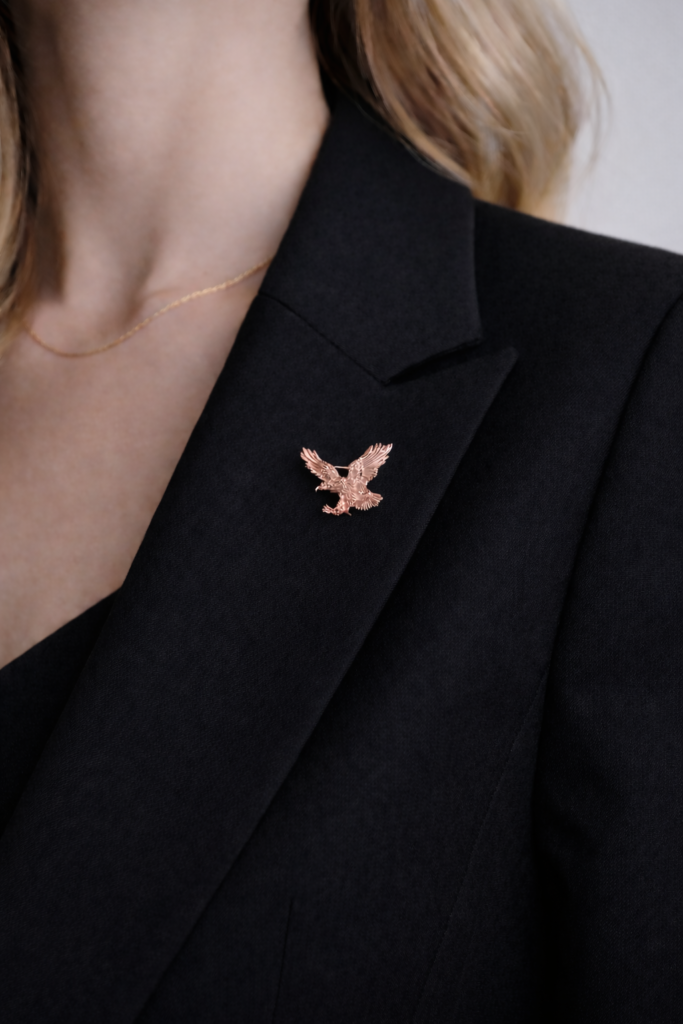
Before we examine the seven essential pieces, we need to establish what old money aesthetic jewelry truly means—because the term has been diluted by TikTok trends and costume jewelry marketed as “vintage-inspired.”
Old money aesthetic jewelry is not simply wearing pearls and calling it hereditary. It’s not buying anything antique and assuming age equals authenticity. It’s definitely not minimalist jewelry with a luxury price tag. And despite what certain influencers suggest, throwing on your grandmother’s costume brooch doesn’t automatically convey generational wealth.
Instead, authentic old money aesthetic jewelry adheres to specific principles:
It prioritizes provenance over newness. Where a piece comes from matters as much as what it is. A Cartier Tank watch purchased at auction carries different weight than the same model bought new from the boutique. The story—real or constructed—adds intangible value that new pieces simply cannot possess.
It favors heritage over trends. Old money families don’t follow fashion; they set it, then ignore it for decades. Their jewelry choices reference historical periods—Victorian sentimentality, Edwardian elegance, Art Deco geometry—rather than current runway moments. The same silhouettes recur: substantial chains, signet rings, pearl strands, tennis bracelets. These pieces transcend temporal boundaries.
It embraces the long game. This is jewelry purchased with the next fifty years in mind. Will this piece look as appropriate in 2075 as it does today? Will it survive changing tastes? Can it be repaired, reset, repurposed? Old money aesthetic jewelry must pass the generational test.
It demonstrates restraint over excess. Counterintuitively, old money aesthetic jewelry often signals more wealth through what’s not worn than what is. A single substantial gold chain makes a stronger statement than five delicate layered necklaces. One perfect pair of diamond studs outranks an ear full of trendy piercings.
The old money mindset approaches jewelry as capital—both financial and social. Each piece should hold value, improve with age, and contribute to a carefully curated personal uniform. This is why old money aesthetic jewelry avoids logos, visible branding, and anything that overtly announces its cost.
The 2020s have witnessed a profound shift in luxury consumption. After decades of conspicuous consumption—logo mania, influencer culture, fast fashion cycles—a counter-movement has emerged. Discerning consumers are gravitating toward pieces that convey sophistication through restraint rather than ostentation through display.
The pandemic triggered widespread reassessment of consumption habits, with many questioning the wisdom of trend-driven purchases that lost relevance within months. Economic uncertainty has made investment pieces—jewelry that holds or appreciates in value—infinitely more attractive than disposable fashion jewelry.
The Crown didn’t just chronicle royal history; it provided a masterclass in how jewelry conveys power, lineage, and identity across generations. Succession‘s Shiv Roy became a style icon precisely because her jewelry whispered rather than shouted: simple gold hoops, a delicate chain, a watch that cost more than most cars but looked understated enough to miss.
Social media has paradoxically democratized access to old money aesthetic jewelry knowledge while simultaneously creating hunger for its codes. Anyone can now study auction house catalogues, follow estate jewelry dealers, and decode the visual language of generational wealth. The information is accessible; the execution requires investment, patience, and taste.
Sustainability concerns have also elevated old money aesthetic jewelry. Buying pieces designed to last generations aligns with environmental values in ways fast fashion jewelry never could. There’s moral superiority in refusing to participate in disposable luxury cycles—and old money families have practiced this philosophy for centuries.
1. The Heirloom Pearl Strand
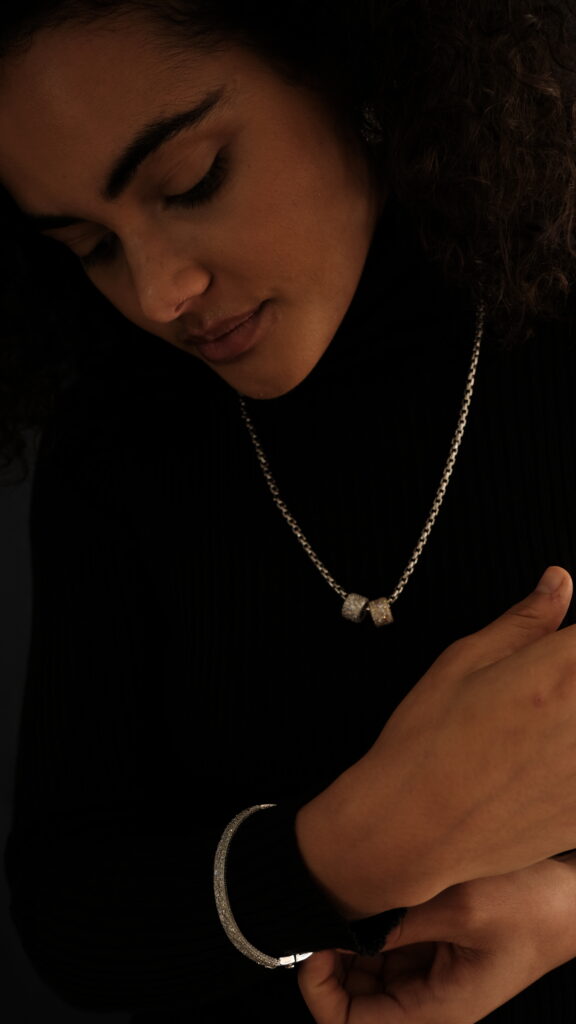
If old money aesthetic jewelry had a singular icon, it would be the pearl strand. Not delicate freshwater pearls on silk cord, but a substantial strand of perfectly matched, lustrous pearls that rests just above or at the collarbone—the kind that looks like it survived three generations of debutante balls and country house weekends.
Before diamonds became engagement ring standards, pearls signaled wealth and status across cultures. European aristocracy adorned themselves in ropes of natural pearls worth more than estates. American heiresses wore pearl chokers as visual shorthand for their families’ fortunes.
Material specifications matter immensely. Authentic old money aesthetic jewelry in this category means Akoya pearls at minimum—those perfectly round, intensely lustrous specimens from Japanese and Chinese waters. South Sea pearls (larger, creamier, more expensive) or Tahitian pearls (dark, sophisticated) work for those with deeper pockets. Freshwater pearls, regardless of quality, read as costume in the old money context.
Size matters strategically. Old money pearl strands typically feature pearls between 7-9mm for Akoya varieties, 10-13mm for South Sea. Anything smaller reads as starter jewelry; anything dramatically larger risks looking nouveau riche. The sweet spot is “substantial but not showgirl.”
The classic princess length (17-19 inches) sits at the collarbone and works for virtually every occasion. This is the daily-wear length, the length that appears in every significant family photograph, the length that layers under turtlenecks and over silk blouses with equal aplomb.
The clasp deserves as much attention as the pearls themselves. Old money aesthetic jewelry favors substantial clasps in 18k gold or platinum, often featuring small diamonds or decorative elements. The clasp should be beautiful enough to wear at the front as a design element.
Styling follows the “never without” philosophy that defines old money aesthetic jewelry. This is jewelry worn daily, not saved for special occasions. It appears over chambray shirts and under navy blazers. It works with everything from black tie to tennis whites.
Where to acquire: Estate sales and auction houses remain goldmines for authentic old money pearl strands. Christie’s and Sotheby’s jewelry auctions regularly feature exceptional examples. For new purchases, Mikimoto remains the standard-bearer, though vintage allows you to skip the decades-long wearing process.
Price expectations: Entry-level vintage Akoya strands from reputable dealers start around $1,500-3,000. Investment-grade examples with exceptional luster and heritage house provenance reach $10,000-25,000.
Common mistakes: Choosing freshwater pearls (instantly reads as contemporary), selecting overly long strands without the lifestyle to support them, opting for unnaturally large pearls, or wearing pearls with obviously modern fashion jewelry.
-
Aku Earrings – 18K Gold, White Gold
£2,813 Add to cart -
Blüte Bracelet 0.48ct – 18K Gold
18K Gold
£10,524 Select options This product has multiple variants. The options may be chosen on the product page -
Katy Necklace – 18K Gold
18K Gold
£2,891 Add to cart
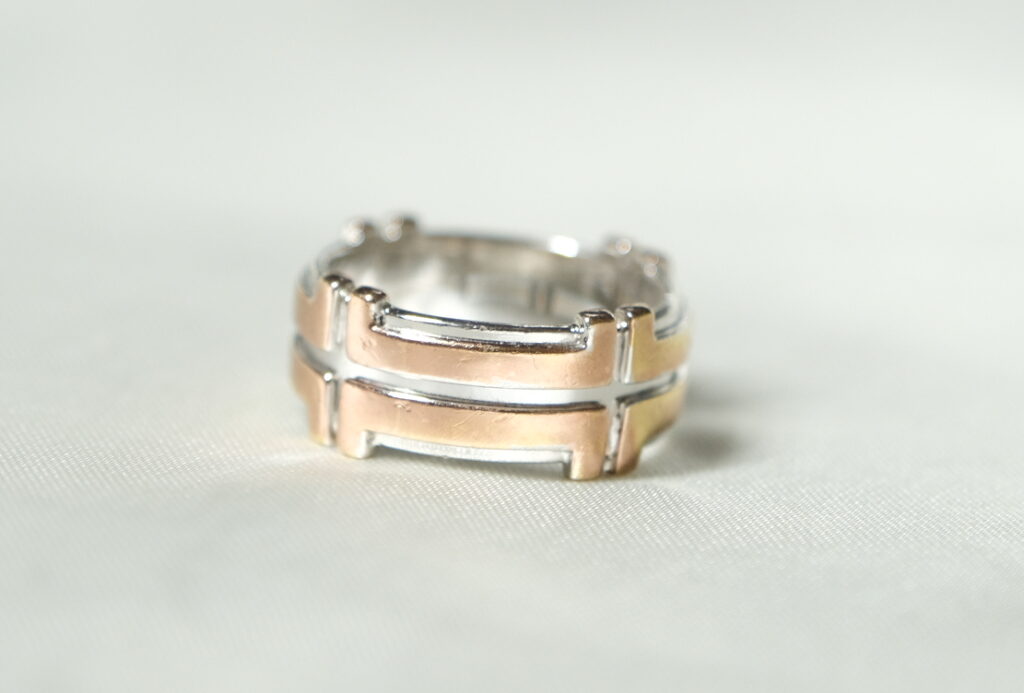
Perhaps no piece of jewelry signals old money aesthetic more immediately than the signet ring. Worn on the pinky finger of the non-dominant hand (traditionally) or the ring finger (modern interpretation), the signet ring represents lineage, family legacy, and heritage that predates social media by centuries.
Historically, signet rings bore family crests or initials pressed into wax to seal documents and letters. Families passed these rings through generations, with each wearer adding their chapter to the ring’s story. The patina, the worn edges, the almost illegible engraving—these imperfections became the point.
Here’s the liberating truth: You don’t need a family crest. You commission one. You start the tradition. You create the heirloom that your grandchildren will wear with the same nonchalance as if it had existed for centuries.
Material specifications are non-negotiable: 18k gold only. Yellow gold dominates with almost tyrannical authority, though rose gold appears occasionally in European contexts. The ring should be substantial—men’s signets often weigh 15-25 grams, women’s 8-15 grams.
The engraving follows strict protocols. Family crests (if you possess one) reign supreme. Initials work beautifully—typically three letters representing first, middle, and last names. The engraving should be deep enough to read but subtle enough to avoid looking freshly done.
Styling rules are remarkably rigid. The signet ring is worn constantly—never removed for manual work (the scratches add character), never switched between hands, never part of a hand full of rings. It pairs with watches, wedding bands, and perhaps one additional simple ring, but never with multiple statement pieces.
The beauty of the signet ring in old money aesthetic jewelry is its complete versatility. It works with everything from bespoke suits to weekend sailing gear. It transcends gender boundaries. It’s jewelry that improves with age and wear.
Investment perspective: Signet rings hold value exceptionally well, particularly vintage examples from heritage houses like Cartier or Van Cleef & Arpels. The initial investment (typically $2,000-8,000 for custom work in 18k gold) seems significant until you calculate cost-per-wear over a lifetime.
Why Inheritance Looks Better Than Purchase (And How to Fake It Flawlessly)
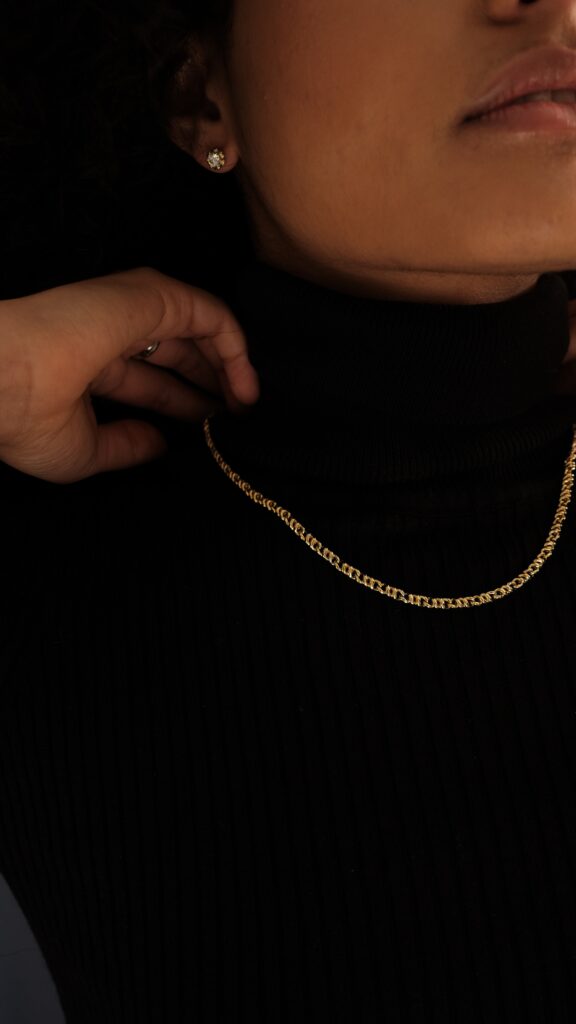
The chain necklace occupies a fascinating position in old money aesthetic jewelry: it’s both the most versatile piece and the easiest to get catastrophically wrong. We’re not discussing delicate chains that disappear against skin. Old money chain necklaces are substantial, architectural, and completely unapologetic about their presence.
Think of the chains worn by Italian grandmothers who weathered wars and raised families. Think of the substantial gold links that appear in Renaissance portraits. Think of jewelry that has weight—literal and metaphorical.
Material specifications: 18k gold in yellow, occasionally rose, almost never white. The weight should be substantial—typically 20-40 grams for a 16-18 inch necklace. Common styles that read as authentically old money include anchor chain, curb chain, rope chain, and belcher chain.
The length matters enormously. The sweet spot sits at 16-18 inches—long enough to rest comfortably at the collarbone, short enough to maintain presence. This length works under crew necks, over collared shirts, and with virtually every neckline.
Gold chains represented portable wealth—jewelry that could be sold if circumstances demanded, worn daily without special occasion requirements, and passed through generations regardless of changing tastes. They were practical luxury.
Styling versatility is where chains excel. This is truly daily-wear jewelry. It layers under turtlenecks in winter, shows against summer linen, works equally well with tailored suits and weekend cashmere. The chain becomes part of your physical signature—always present, never requiring thought.
Where to find them: Estate sales remain the most reliable source for authentic old money chains at reasonable prices. The family liquidating grandmother’s jewelry often undervalues the simple gold chain while overpricing gemstone pieces.
Price expectations: $1,500-4,000 for vintage 18k gold chains of appropriate weight and style, to $5,000-15,000 for exceptional examples with notable provenance. Remember: you’re buying by gold weight plus craftsmanship premium.
Common mistakes: Choosing chains that are too delicate, selecting white gold (too contemporary), opting for plated or 14k gold (instantly reads as costume), or wearing chains with multiple pendants.
4. The Tennis Bracelet or Substantial Bangle
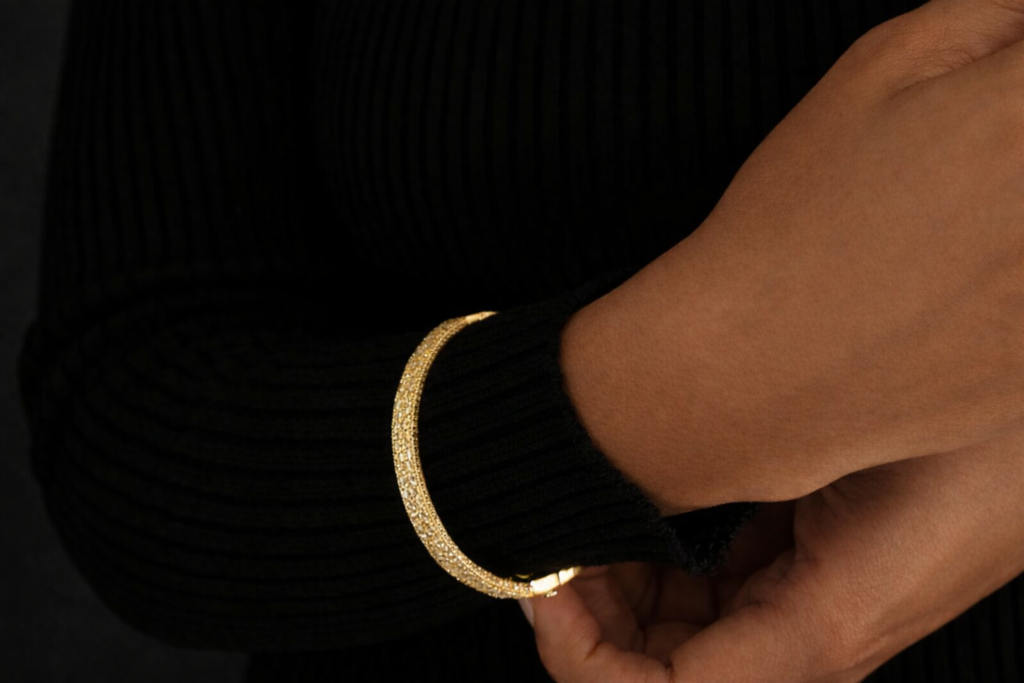
The tennis bracelet entered popular consciousness in 1987 when professional tennis player Chris Evert’s diamond bracelet broke during a match, causing her to ask officials to pause play. But the form—a continuous line of diamonds set in precious metal—predates Evert’s incident by decades.
In the context of old money aesthetic jewelry, the tennis bracelet represents understated luxury at its finest: significant diamonds worn so casually that they accompany athletic activities.
Material specifications: 18k white gold or platinum for the setting, with diamonds of consistent quality throughout. This consistency matters enormously. Each diamond should match its neighbors in size, cut, color, and clarity—a commitment that significantly impacts cost but creates the seamless appearance that defines the style.
Diamond quality follows the “excellent but not flawless” philosophy. We’re targeting G-H color (near colorless), VS1-VS2 clarity (eye-clean), and excellent cut quality. Total carat weight typically ranges from 3-7 carats for a 7-inch bracelet.
The setting style matters as much as the diamonds. Classic old money tennis bracelets use four-prong settings that allow maximum light to enter each diamond. Individual diamond size usually ranges from 0.15-0.35 carats each—large enough to read as substantial, small enough to avoid looking excessive.
The alternative: A substantial bangle in 18k gold with enough weight to feel significant. A 15-20 gram gold bangle worn on one wrist provides instant polish while maintaining the restraint essential to old money style.
Styling philosophy: These pieces should be worn constantly—to the gym, to bed, to the beach, to board meetings. They improve with slight scratches and daily wear, developing the patina that distinguishes old money aesthetic jewelry from obviously new purchases.
Where to acquire: Estate sales and auction houses offer the best value for tennis bracelets, as the secondary market discount on diamond jewelry can be substantial.
Price expectations: Entry-level tennis bracelets with respectable diamonds start around $4,000-6,000. Investment-grade examples with superior diamonds and heritage house provenance reach $15,000-40,000. The sweet spot falls around $8,000-12,000.
For gold bangles, pricing depends on weight and purity. A substantial 18k gold bangle weighing 20 grams might cost $2,000-3,000 based on current gold prices.
-
Cluster Stud Diamond Earrings-18K White Gold-1.7ct
18K White Gold
£4,880 Add to cart -
Linear Diamond Tip Bracelet 0.43ct – 18K Rose Gold
18K Rose Gold
£13,655 Select options This product has multiple variants. The options may be chosen on the product page -
Mosaïque Bracelet – Sterling Silver
Sterling Silver
£451 Select options This product has multiple variants. The options may be chosen on the product page
5. The Everyday Diamond Studs
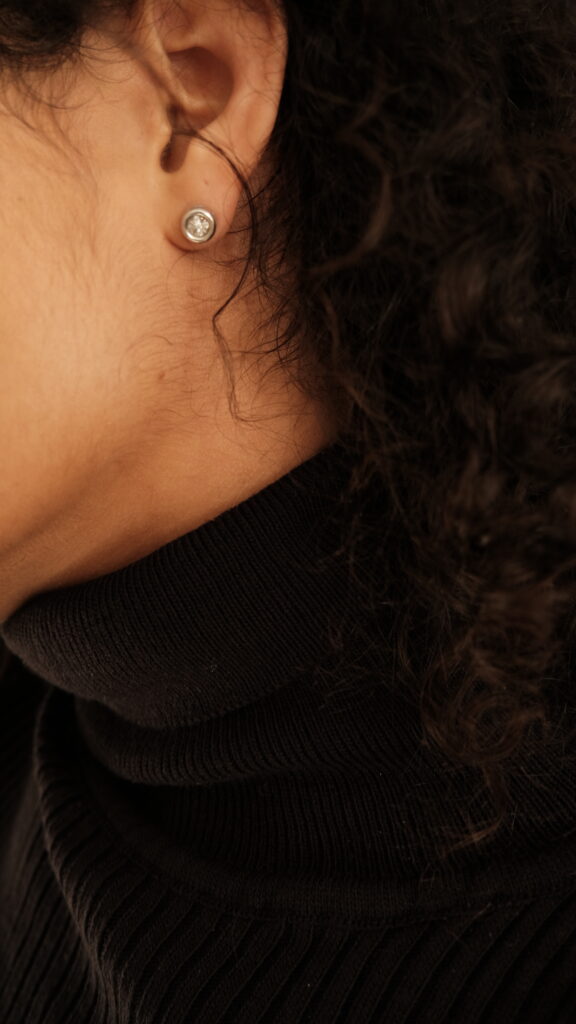
If you could own only one piece from the old money aesthetic jewelry canon, diamond studs would be the defensible choice. They work with literally everything, from black-tie to workout gear. They transcend age, generation, gender, and occasion.
But not just any diamond studs qualify. We’re discussing substantial diamond studs—minimum 0.75 carats total weight (ctw), ideally 1.0-2.0 ctw—in classic settings that will look identical in photographs from 1950, 2025, and 2075.
Material specifications: Round brilliant cut diamonds in platinum or 18k white gold settings. The classic four-prong setting dominates old money aesthetic jewelry for diamond studs, offering the perfect balance of security and light performance.
Diamond quality follows the “excellent in the ways that matter, pragmatic elsewhere” approach. Color should be G-H minimum. Clarity should be VS2-SI1 range—eye-clean when viewed from conversational distance. Cut quality cannot be compromised: Excellent or Ideal cut diamonds are non-negotiable.
Size considerations require honest self-assessment. Old money aesthetic jewelry studs should be substantial enough to read from across a room—which typically means 0.75 ctw minimum, with 1.0-1.5 ctw hitting the sweet spot. Larger than 2.0 ctw total weight risks entering territory where the diamonds demand too much attention.
Styling rules are refreshingly simple: wear them constantly. Diamond studs should be your default earring, removed only when a specific occasion demands alternative jewelry. They work with everything and layer beautifully with pearl strands, gold chains, and other old money pieces.
Where to acquire: Estate sales offer exceptional value for diamond studs, as they’re often overlooked in favor of flashier pieces. Auction houses regularly feature diamond studs from estate collections.
Price expectations: Entry-level old money aesthetic jewelry studs (0.75-1.0 ctw, VS2-SI1 clarity, G-H color) start around $3,000-5,000 from independent jewelers. Investment-grade examples (1.5-2.0 ctw with superior quality) range $8,000-15,000.
Common mistakes: Choosing diamonds that are too small, selecting poor-quality diamonds to achieve larger size, opting for overly trendy settings, or choosing yellow gold settings (beautiful but more fashion-forward for diamond studs specifically).
6. The Heritage Timepiece
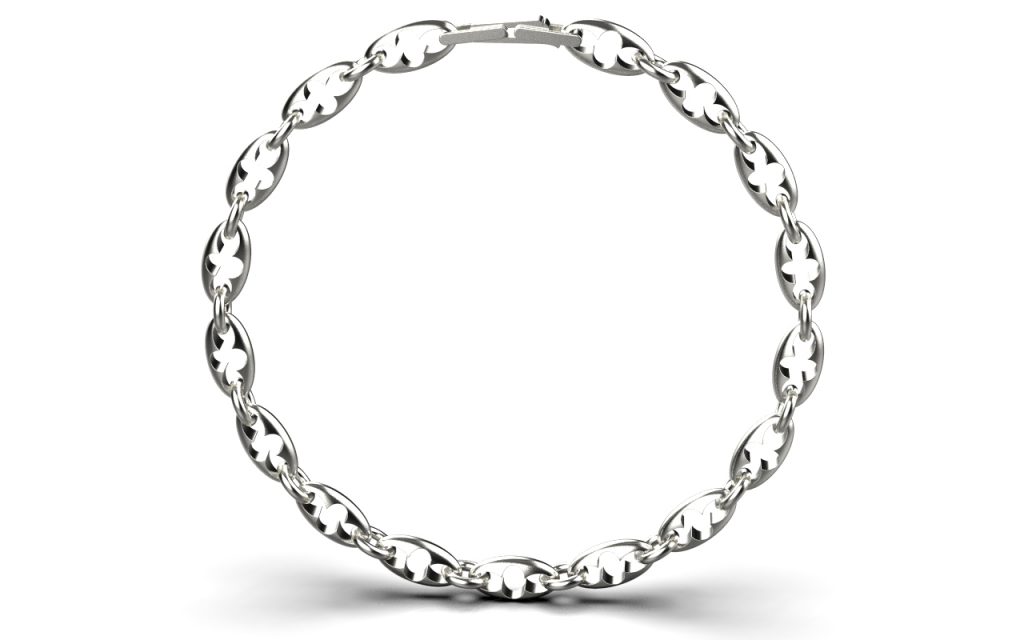
The watch occupies unique territory in old money aesthetic jewelry. It’s the one piece where brand matters as much as age, where mechanical complexity is celebrated, and where masculine and feminine versions follow completely different rules.
For women, the old money watch universe revolves around a surprisingly narrow range. The Cartier Tank—particularly vintage models from the 1970s-90s—dominates with almost tyrannical authority. Its rectangular case, Roman numerals, and blue cabochon crown have defined elegant women’s watches since 1917. Alternatives include the Jaeger-LeCoultre Reverso and vintage Rolex Oyster Perpetual models.
For men, the landscape expands while maintaining strict parameters:
- Rolex: Submariner, GMT-Master, Datejust (sporty elegance, tool watch heritage)
- Patek Philippe: Calatrava, Nautilus (ultimate prestige, generational thinking)
- Audemars Piguet: Royal Oak (integrated bracelet, controversial but undeniably established)
Secondary tier includes Omega (vintage Speedmasters and Seamasters), Jaeger-LeCoultre (Reverso, Master Control), and Vacheron Constantin.
The mechanical movement requirement is non-negotiable. Quartz watches, regardless of brand or price, contradict the old money aesthetic jewelry philosophy. Mechanical watches require winding, maintenance, and servicing—they demand relationship and attention. This imperfection is precisely the point.
The dial should be simple, classic, and legible. Avoid skeletonized dials, overly complicated chronographs (unless you’re buying a Speedmaster or Daytona for specific heritage reasons), or anything trying too hard to be interesting.
The concept of patina becomes crucial. Vintage watches with honest wear—scratches on cases, aged lume on dials, slightly worn bezels—read as more authentic than pristine examples. A 1970s Rolex Submariner with desk-diving scratches tells a better story than a mint condition example that clearly lived in a safe.
Where to acquire: Reputable vintage dealers (Crown & Caliber, Hodinkee, European Watch Company) authenticate pieces and provide warranties. Auction houses offer exceptional examples but require bidding sophistication.
Price expectations: Entry-level vintage women’s Cartier Tanks start around $2,500-4,000. Men’s vintage Rolex Submariner or GMT-Master references range $8,000-25,000 depending on reference and condition. The sweet spot for most collectors falls around $5,000-15,000.
7. The Convertible Statement Piece
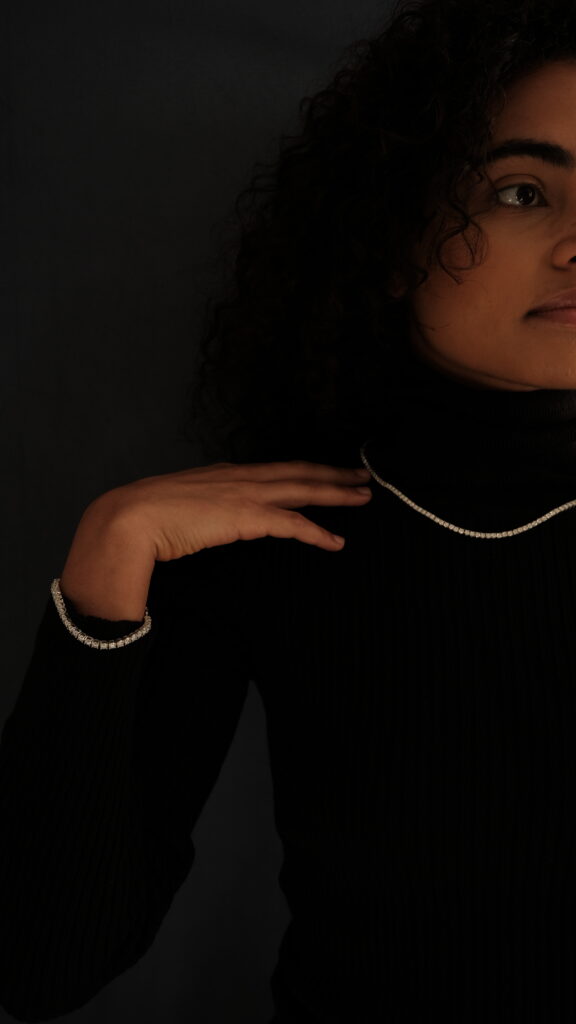
The final essential in old money aesthetic jewelry introduces flexibility and personality while maintaining core principles of heritage, quality, and timelessness. Convertible pieces—jewelry designed to be worn multiple ways—represent the practical luxury that old money families have always valued.
The convertible jewelry category includes brooches that convert to pendants, earrings with removable elements, and necklaces that separate into bracelets. This is your statement jewelry—the one piece that introduces color, gemstones, or design elements beyond foundational simplicity.
Material and gemstone choices follow the “heritage over trend” mandate. Preferred gemstones include sapphires (particularly Ceylon sapphires in cornflower blue), emeralds (Colombian preferred), rubies (Burmese traditionally most prized), and old mine cut or old European cut diamonds.
Avoid: Trendy gemstones (morganite, aquamarine in contemporary settings), synthetic stones, overly modern design languages, or anything that will obviously date itself within a decade.
The setting should be 18k gold (yellow, rose, or occasionally white) or platinum, with craftsmanship quality immediately apparent. Hand-engraving, milgrain details, filigree work—these traditional techniques separate investment pieces from costume jewelry.
Size and scale require calibration. This is your opportunity to introduce visual impact, but old money aesthetic jewelry avoids anything costume-sized or obviously attention-seeking. The piece should be substantial enough to read from across a room but refined enough to wear without feeling like you’re playing dress-up.
Styling versatility is the point. A brooch-pendant worn as a brooch introduces formality to suits, coats, and evening wear. The same piece worn as a pendant on a gold chain becomes daily jewelry appropriate for any context.
Where to acquire: Auction houses are goldmines for exceptional estate convertible pieces. Christie’s and Sotheby’s jewelry auctions regularly feature signed examples from heritage houses at prices below replacement cost.
Price expectations: $5,000-15,000 for quality estate convertible pieces with respectable gemstones, to $25,000-75,000+ for signed examples from major houses. The sweet spot falls around $10,000-20,000.
Old Money Aesthetic Jewelry as Investment Strategy
Building an old money aesthetic jewelry collection requires capital. But here’s where the old money mindset diverges from conventional jewelry consumption: this is investment, not expense.
Wealthy families who established these codes didn’t view jewelry as decoration. They understood it as portable capital, as insurance against uncertainty, as tangible assets that could be liquidated, used as collateral, or passed through generations while appreciating in value.
The long-game strategy involves building the collection over time. Start with one foundational piece—perhaps the pearl strand or gold chain—and wear it constantly for a year while saving for the next addition. This approach builds the patina of daily wear essential to the aesthetic and prevents the “just bought my entire inheritance” look.
Consider the mathematics. A $5,000 pearl strand worn daily for thirty years costs approximately $0.45 per wear. If that strand appreciates to $8,000 over those three decades (conservative estimate for quality pieces), you’ve essentially been paid to wear it.
The sustainability argument is equally compelling. Buying seven investment pieces that last lifetimes generates infinitely less environmental impact than cycling through hundreds of trend-driven jewelry purchases. There’s moral clarity in refusing to participate in disposable luxury cycles.
Insurance and appraisal considerations become relevant as collections grow. Investment-grade old money aesthetic jewelry should be professionally appraised every 3-5 years and properly insured. Most homeowner’s or renter’s insurance policies provide inadequate coverage for valuable jewelry.
Proper care extends jewelry lifespans significantly. Gold requires minimal maintenance. Pearls demand more attention: wipe with a soft cloth after each wear, store away from other jewelry, and restring periodically. Watches require regular servicing from authorized technicians.
-
Baguette Eternity Band Ring 0.77ct – Platinum
Platinum 950
£2,732 Select options This product has multiple variants. The options may be chosen on the product page -
Ball Torque Bracelet 0.12ct – Platinum
Platinum 950
£4,428 Select options This product has multiple variants. The options may be chosen on the product page -
Loop Earrings – 18K Rose Gold- 1.026ct
18K Rose Gold
£4,960 Select options This product has multiple variants. The options may be chosen on the product page
The Old Money Color Palette: Understanding Metal Choices
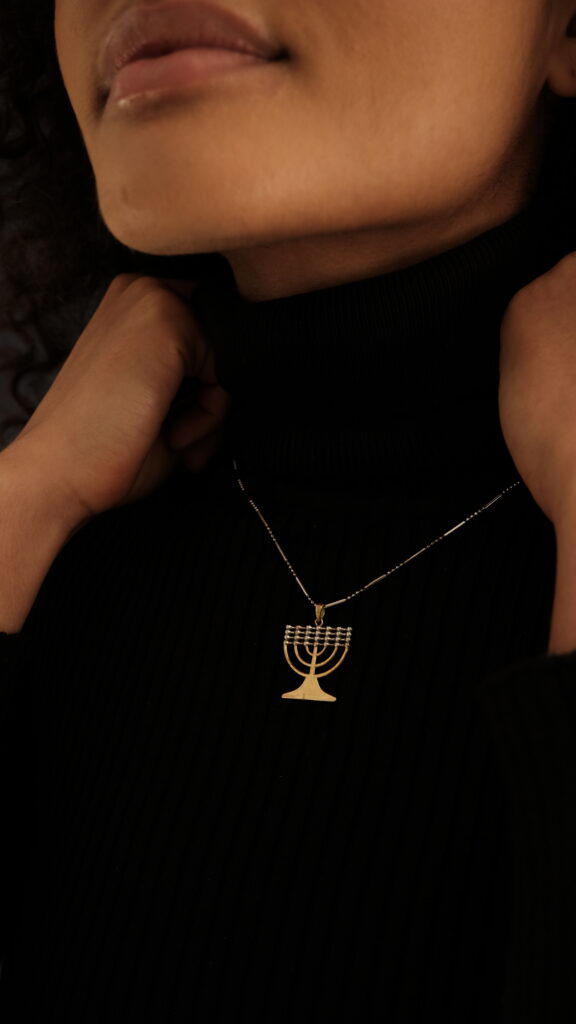
Metal choices in old money aesthetic jewelry follow strict hierarchies that signal taste, understanding, and belonging.
Yellow gold reigns supreme. Specifically, 18k yellow gold dominates with almost tyrannical authority. Yellow gold has been the metal of wealth for millennia. It doesn’t tarnish, it ages beautifully, it develops patina that adds character, and it photographs consistently across decades.
The warmth of 18k yellow gold flatters virtually all skin tones, works across seasons, and pairs beautifully with materials that dominate old money wardrobes: navy wool, crisp white cotton, camel cashmere.
Platinum enters old money aesthetic jewelry in specific contexts: engagement rings, wedding bands, and pieces featuring white diamonds where maximum sparkle is desired. Platinum’s naturally white color doesn’t compete with diamonds, and its density makes it ideal for daily-wear pieces.
Rose gold occupies interesting territory. In European old money contexts, rose gold carries legitimate heritage credentials. Victorian and Art Deco pieces frequently featured rose gold. However, in American old money aesthetic jewelry, rose gold is approached more cautiously—it’s seen as more fashion-forward, less eternal than yellow gold.
White gold is the most controversial metal. Contemporary white gold is decidedly modern. It requires periodic re-plating, and it doesn’t have the generational track record that yellow gold or platinum possess. White gold often reads as “trying to look like platinum while paying gold prices.”
The practical recommendation: choose your primary metal (yellow gold for most people following old money aesthetic jewelry principles) and make that 80-90% of your collection. Allow platinum for specific pieces where it makes technical sense. Treat rose gold and white gold as accent metals.
Building Your Collection: Practical Acquisition Strategy
The gap between understanding old money aesthetic jewelry and actually acquiring a collection feels daunting when you’re starting without family pieces or trust fund capital. The good news: building an authentic collection is entirely achievable with strategic thinking and patience.
Start with one foundational piece and wear it obsessively for a year. Choose either the gold chain, pearl strand, or signet ring as your entry point. During that first year, save aggressively for the second piece while researching extensively. Follow auction house results to understand pricing. Study estate jewelry dealers to recognize quality markers.
The estate sale and auction strategy requires specific skills but offers exceptional value. Estate sales frequently undervalue jewelry compared to furniture or art. The family liquidating grandmother’s estate often prices the simple gold chain at melt value while dramatically overpricing costume pieces.
Auction houses offer transparency and authentication. Major houses like Christie’s and Sotheby’s provide detailed condition reports, gemological certificates, and expertise you can trust. Understanding buyer’s premiums (typically 20-25% on top of hammer price) increases confidence and success rates.
Online vintage jewelry platforms have matured significantly. Reputable dealers like Erie Basin, Doyle & Doyle, and Lang Antiques offer authenticated pieces with return policies and expert knowledge.
Budget allocation should follow the 50/30/20 framework: 50% of your jewelry budget toward the seven foundational pieces, 30% toward quality over quantity, and 20% toward wild cards—pieces that speak to you personally.
The timeline for building a complete old money aesthetic jewelry collection realistically spans 5-10 years for most people building from scratch. This isn’t failure; it’s authenticity. Collections built over time develop the lived-in quality that instant collections can never achieve.
Common pitfalls to avoid: Rushing to complete the collection (creates the “too new” problem), buying low-quality versions to check boxes (undermines the investment philosophy), choosing trendy interpretations over classic forms, or assuming you need everything immediately.
-
Asscher Cut Ring 18K Rose Gold- 0.20ct
18K Rose Gold
£4,025 Select options This product has multiple variants. The options may be chosen on the product page -
Cross Link Necklace – Sterling Silver
Sterling Silver
£737 Select options This product has multiple variants. The options may be chosen on the product page -
Empire Earring – 18K Sterling Silver
Sterling Silver
£434 Add to cart
The Difference Between Old Money Aesthetic Jewelry and Actual Family Jewels
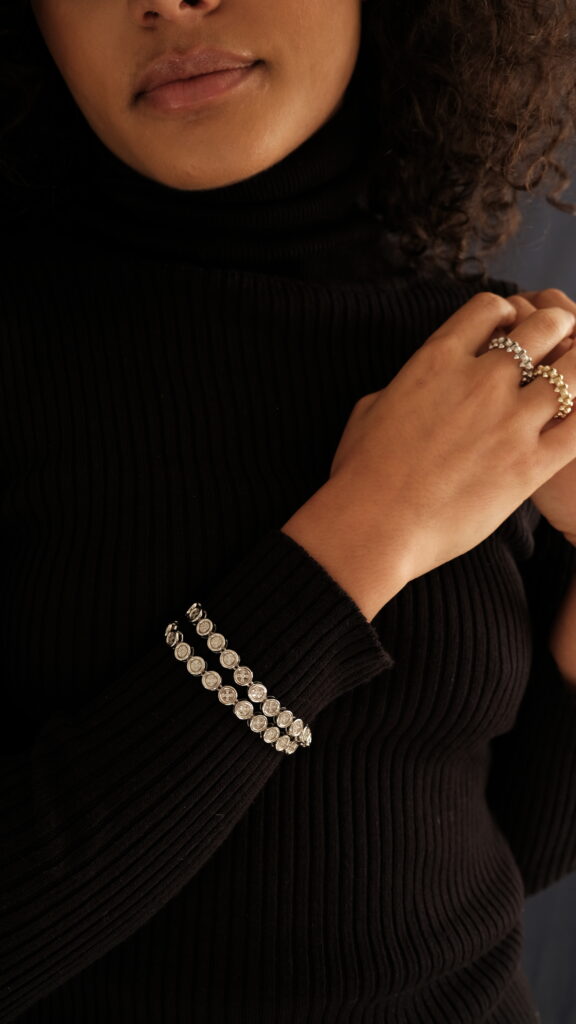
This distinction deserves explicit attention because confusion undermines many people’s confidence. Here’s the truth: you don’t need inherited jewelry to achieve the old money aesthetic jewelry look. You need to understand what inherited jewelry actually looks like and build your collection accordingly.
Actual family jewels carry specific characteristics. They show wear patterns from multiple people. They often mix eras. They include pieces of varying importance. They tell specific stories.
Old money aesthetic jewelry that you’re building yourself can’t replicate these specific elements—and that’s completely acceptable. What you can achieve:
The visual language of inheritance. Buying vintage and estate pieces rather than contemporary jewelry provides instant history. A 1970s Cartier Tank looks inherited even if you purchased it last year.
The quality markers of generational pieces. Focusing on 18k gold, substantial carat weights, heritage houses, and classic designs ensures that your collection could plausibly be inherited.
The patina of wear. Daily wearing your collection accelerates the development of authentic wear patterns. A gold chain worn constantly for five years develops character that a safe-kept chain never will.
The cohesive aesthetic of thoughtful curation. Your collection can exhibit coherence through strategic acquisition rather than generational accident.
The psychological barrier many people face: “Won’t people know I bought this myself?” Here’s the liberating truth: nobody worth impressing cares whether you inherited your jewelry or built the collection yourself. What matters is taste, quality, and the confidence to wear it as if it has always been yours.
Conclusion: Old Money Aesthetic Jewelry as Generational Thinking
Building a collection of old money aesthetic jewelry represents a fundamental shift in how we approach luxury. It requires rejecting the dopamine hits of trend-driven purchases in favor of the long-term satisfaction of owning fewer, better pieces that improve with time.
The seven foundational pieces explored in this article—the pearl strand, signet ring, gold chain, tennis bracelet, diamond studs, heritage timepiece, and convertible statement piece—aren’t just jewelry categories but philosophical commitments.
Each piece should pass the generational test: Will this look as appropriate in 2075 as it does today? Will my grandchildren want to wear it? Does it transcend temporal boundaries in ways that most contemporary jewelry cannot?
The beauty of mastering old money aesthetic jewelry in 2026 is that the information has been democratized even as the aesthetic remains exclusive. You can study auction results, follow estate jewelry dealers, research heritage houses, and educate yourself to a degree previous generations couldn’t access. Knowledge is available; execution still requires capital, patience, and taste.
But the investment—both financial and philosophical—compounds over time. The pearl strand purchased this year will be worn 500 times over the next decade, developing patina and personal history. The gold chain becomes inseparable from your physical presence. The diamond studs photograph consistently across decades of life moments.
In fifty years, when your granddaughter inherits your carefully curated collection of old money aesthetic jewelry, she won’t remember that you built it from scratch rather than inheriting it yourself. She’ll see pieces worthy of inheritance, jewelry that transcends trends, and the foundation of a tradition she can continue.
That’s the ultimate achievement of old money aesthetic jewelry: creating something that appears to have always existed while actually building it deliberately, thoughtfully, and with future generations in mind. It’s luxury that looks backward and forward simultaneously, rooted in history while creating new legacies.
The seven pieces explored in this article aren’t a shopping list to complete in a weekend. They’re a framework for decades of thoughtful acquisition, a North Star for quality and taste, and an invitation to participate in generational thinking regardless of your actual family history. Build the collection slowly. Wear it constantly. Pass it down proudly.