

Precious Metals
SCULPTURAL SILVER VS MINIMALIST GOLD: WHICH STYLE SPEAKS TO YOUR SOUL?
A diamond cut is a key factor to consider when choosing your next piece of diamond jewelry.
By Chinwe, Chief Creative Officer
The sculptural silver vs minimalist gold debate isn’t about which metal costs more or photographs better on Instagram. It’s about something far more personal: the visual language you speak when you walk into a room, the emotional weight you assign to adornment, and whether you find power in drama or restraint. This isn’t a trend piece. This isn’t a buying guide disguised as editorial. This is an exploration of two fundamentally different aesthetic philosophies—and how understanding the material character, design psychology, and visual physics of sculptural silver vs minimalist gold can help you build a jewelry wardrobe that actually reflects who you are, not who the algorithm thinks you should be.
This article will explore:
- What sculptural silver vs minimalist gold actually represents as a design philosophy—and what this debate is absolutely not
- Why the sculptural silver vs minimalist gold tension has become the defining aesthetic divide in contemporary jewelry
- The visual physics of each pairing: how form, material, and proportion create completely different emotional signatures
- Material character decoded: silver’s reflective drama vs gold’s warm luminosity—and how each metal amplifies or softens sculptural vs minimal design
- How personal style identity, not trend forecasts or metal hierarchies, should drive your sculptural silver vs minimalist gold choice
- Wardrobe integration strategies: pairing sculptural silver with architectural clothing vs styling minimalist gold with refined classics
- The versatility question: can one aesthetic do it all, or does mixing sculptural silver and minimalist gold create the most sophisticated wardrobe?
- How to curate an intentional jewelry collection in either (or both) aesthetic directions without compromising your visual identity
We’ve moved past the era when jewelry was categorized by occasion, gender, or age-appropriateness. The rigid rules that once dictated “gold for formal, silver for casual” or “statement pieces for special events only” have collapsed under the weight of their own irrelevance. What’s emerged in their place is something far more interesting: the sculptural silver vs minimalist gold divide—a question that has less to do with metal preference and everything to do with how you want to occupy space in the world.
This isn’t about choosing between expensive and affordable. It’s not about trendy versus timeless, or even warm metals versus cool. The sculptural silver vs minimalist gold conversation is about visual weight. About whether you find beauty in volume and negative space or precision and restraint. About whether your jewelry should command attention through architectural presence or create impact through refined understatement.
Here’s what makes the sculptural silver vs minimalist gold debate so compelling: both approaches, when executed with intention and artistry, are equally sophisticated. Neither is inherently more versatile, more wearable, or more “correct.” What differs is the emotional energy they project and the design philosophy they represent. Sculptural silver speaks the language of bold artistic vision, tactile presence, and unapologetic visibility. Minimalist gold communicates quiet confidence, considered simplicity, and the kind of restraint that requires absolute design precision to execute well.
The rise of sculptural silver vs minimalist gold as the central tension in contemporary jewelry reflects broader cultural shifts: the death of prescriptive style rules, the elevation of jewelry as wearable art, the growing rejection of gendered design assumptions, and the collision between maximalism and quiet luxury as competing lifestyle philosophies. We’re living in an era where a chunky oxidized silver cuff can be just as investment-worthy as a whisper-thin gold bangle—and where understanding which aesthetic resonates with your personal style philosophy is more valuable than following any trend forecast.
This article won’t tell you which side of the sculptural silver vs minimalist gold divide you should land on. What it will do is unpack the design principles, material characteristics, and psychological undercurrents that make each approach distinct—so you can build a jewelry wardrobe that feels like an authentic extension of how you move through the world, not a collection of pieces that looked good on someone else.
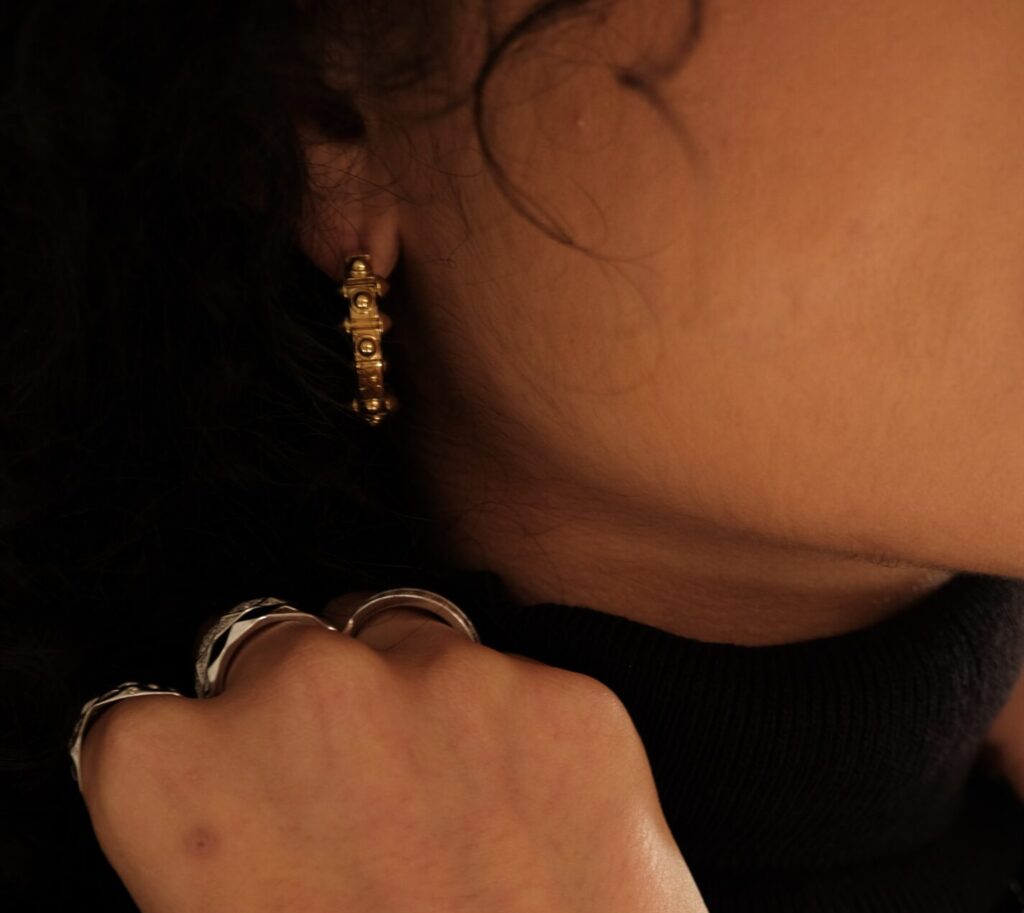
Let’s establish what we’re really discussing when we talk about sculptural silver vs minimalist gold—because this conversation has been muddied by outdated assumptions, trend-driven content, and persistent metal hierarchies that deserve to be dismantled.
Sculptural silver vs minimalist gold is NOT:
- Cheap vs expensive (both can occupy luxury price points; artisan sculptural silver often costs more than mass-produced minimalist gold)
- Casual vs formal (both aesthetics translate across contexts when designed with sophistication)
- Bold vs boring (minimalism executed poorly is boring; executed well, it’s radical restraint)
- Trendy vs classic (sculptural jewelry has ancient roots; minimalist design has been a modernist principle for over a century)
- Masculine vs feminine (both aesthetics are profoundly gender-neutral when freed from marketing stereotypes)
- Statement vs everyday (plenty of sculptural pieces are daily staples for those who dress architecturally; minimalist gold can be just as deliberate a statement)
What sculptural silver vs minimalist gold ACTUALLY represents:
Design Philosophy as Identity Sculptural silver typically embodies maximalist principles: volume, texture, dimensionality, negative space, and the celebration of metal as material with physical presence. It’s jewelry that wants to be seen, touched, and understood as an art object that happens to be wearable. Minimalist gold, conversely, is rooted in reductionist design: the elimination of everything except the essential line, curve, or geometric form. It’s jewelry that creates impact through what’s been removed rather than what’s been added.
Visual Weight and Spatial Relationship The sculptural silver vs minimalist gold divide is fundamentally about how jewelry occupies space on the body. Sculptural pieces—especially in silver’s reflective, high-contrast finish—command attention through three-dimensional form, casting shadows and catching light with architectural drama. Minimalist gold creates presence through precision: the perfect thickness of a hoop, the exact diameter of a cuff, the calibrated proportion of a chain link. One aesthetic announces itself through volume; the other through refined exactitude.
Material Character and Optical Properties Silver’s inherent brightness, cool tone, and reflective quality amplify sculptural forms—making shapes appear larger, bolder, more graphically defined. Gold’s warm luminosity and softer glow harmonize with skin tones, allowing minimalist designs to sit close to the body without visual disruption. The sculptural silver vs minimalist gold pairing isn’t arbitrary; each metal’s optical properties naturally enhance their respective design approaches.
Emotional Resonance and Self-Expression Perhaps most critically, the sculptural silver vs minimalist gold question reveals how you relate to visibility and restraint. Do you find power in being unmissable, in wearing your aesthetic convictions on your body? Or do you experience confidence through curation, through the discipline of choosing only what’s essential and refusing embellishment? Neither answer is superior—but understanding which resonates with your core identity is essential to building an authentic jewelry wardrobe.
The sculptural silver vs minimalist gold conversation only becomes meaningful when we strip away the outdated hierarchies and acknowledge that this is a choice between two equally valid forms of beauty, two distinct design languages, and two fundamentally different ways of using adornment to express personal style.
-
Amoure Necklace – 18K Gold, Rhodium Plated Sterling Silver
Sterling Silver
£918 Select options This product has multiple variants. The options may be chosen on the product page -
Sale!
Arc Ring – 18K White Gold 0.24ct
18K White Gold
£2,605 Select options This product has multiple variants. The options may be chosen on the product page -
Esther Link Bracelet – 18K Gold, Rose Gold Plated Sterling Silver
Sterling Silver
£446 Select options This product has multiple variants. The options may be chosen on the product page
2. The Visual Physics: How Form and Material Create Completely Different Signatures
Understanding sculptural silver vs minimalist gold requires unpacking the material science and design physics that make each combination create such radically different visual experiences.
Silver’s Sculptural Amplification
Silver possesses one of the highest reflective indices of any metal used in jewelry—which means it bounces light with exceptional intensity and contrast. When applied to sculptural forms—chunky cuffs, oversized hoops, abstract organic shapes, architectural bangles—this reflectivity creates visual drama. The metal doesn’t just sit on your wrist; it actively participates in the visual field, creating highlights, shadows, and dimensional depth.
Sculptural silver pieces often incorporate:
- Volume and negative space: Large forms interrupted by cutouts, voids, or open structures that create visual rhythm
- Surface treatments: Hammered textures, oxidized finishes, brushed surfaces that add tactile complexity and reduce shine for matte drama
- Asymmetry and organic forms: Freeform shapes, irregular edges, and biomorphic curves that reference nature, geology, or abstract art
- Stacking and layering potential: Pieces designed to interact with each other, creating visual conversation through repetition or contrast
The sculptural silver aesthetic thrives on presence through mass. Even when pieces incorporate negative space, they occupy volume. They have weight—both physical and visual. They transform the body part they adorn into a focal point.
Gold’s Minimalist Refinement
Gold’s warm, soft glow creates an entirely different optical experience. Unlike silver’s high-contrast reflectivity, gold harmonizes with skin tones—particularly yellow and rose gold, which share undertones with human complexion. This means minimalist gold can achieve impact through presence without disruption.
Minimalist gold design relies on:
- Geometric precision: Perfect circles, clean lines, symmetrical forms executed with exacting tolerances
- Proportion and scale: The exact thickness of a wire, the precise diameter of a hoop, the calibrated width of a cuff—every millimeter matters
- Surface finish control: High polish for maximum luminosity, brushed for subtle texture, matte for contemporary sophistication
- Negative space as design element: What’s absent is as important as what’s present—the space between a delicate chain’s links, the opening of a cuff
- Repetition and uniformity: Identical forms stacked or layered to create rhythm through consistency rather than variety
The minimalist gold philosophy achieves impact through restraint. These pieces don’t command attention through size; they earn it through perfection of form. The beauty lies in the discipline—the refusal to add ornament, texture, or complexity when a single perfect line will suffice.
The Material-Design Synergy
The sculptural silver vs minimalist gold pairing works because each metal’s inherent properties enhance its associated design philosophy:
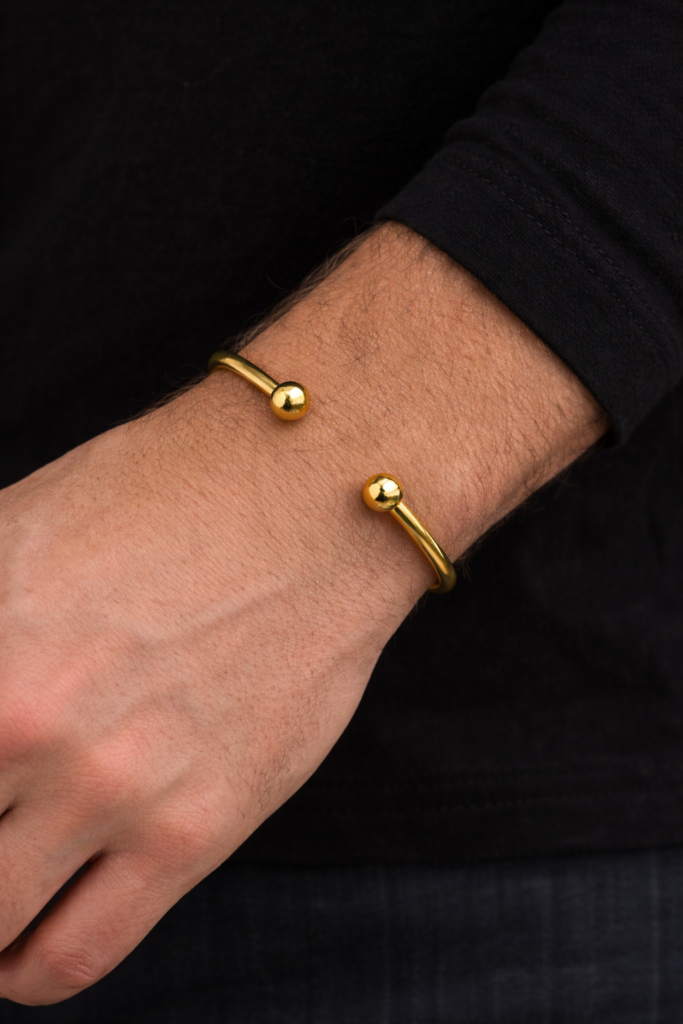
- Silver’s coolness + sculptural volume = graphic, architectural drama
- Gold’s warmth + minimalist precision = understated, refined elegance
Could you create sculptural gold or minimalist silver? Absolutely—and many designers do. But there’s a reason the sculptural silver vs minimalist gold divide has become shorthand for this aesthetic tension: the materials naturally amplify the design approaches they’re most commonly paired with.
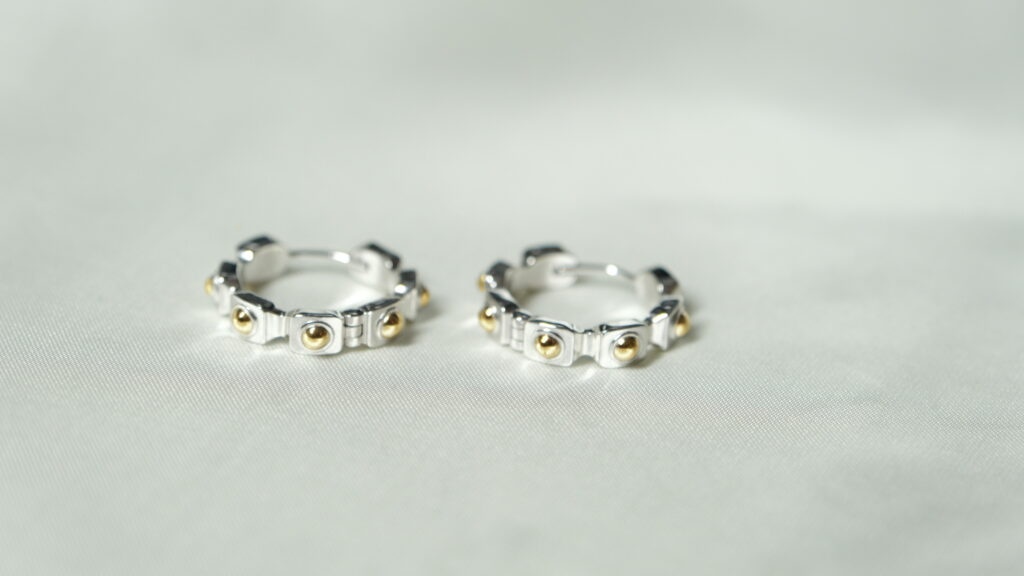
3. Material Character Decoded: Patina, Maintenance, and the Aging Process
One of the most overlooked aspects of the sculptural silver vs minimalist gold conversation is how each metal develops character over time—and how this aging process aligns with (or challenges) each aesthetic philosophy.
Silver’s Living Patina
Silver tarnishes. This isn’t a flaw—it’s a feature, particularly for sculptural silver pieces where patina can enhance dimensionality and depth. Oxidized silver (intentionally darkened through chemical treatment) has become a signature finish for contemporary sculptural jewelry, creating dramatic contrast between polished highlights and matte shadows.
The sculptural silver maintenance reality:
- Tarnish develops character: darkened recesses emphasize form and texture
- Many wearers embrace natural patina as part of the piece’s evolution
- Polishing is optional and preferential—some keep pieces mirror-bright, others never polish
- Oxidized finishes can be refreshed if desired or allowed to wear naturally through use
- The metal’s softness means sculptural pieces can develop small dings and marks that add to their handmade, artisanal quality
For those drawn to the sculptural silver aesthetic, the metal’s tendency to develop patina often aligns with their appreciation for material authenticity and visible history. These aren’t pieces meant to remain pristine—they’re designed to live, age, and accumulate the visual evidence of being worn.
Gold’s Enduring Luster
Gold doesn’t tarnish. It maintains its color, its glow, its surface quality with minimal intervention. For minimalist gold jewelry—where the entire design impact relies on perfect execution—this permanence is essential.
The minimalist gold maintenance reality:
- High polish stays bright with occasional cleaning
- Matte and brushed finishes maintain their texture
- The metal’s durability means pieces resist scratches better than silver (particularly in higher karats)
- No patina development—the piece looks essentially the same year after year
- Investment in quality means longevity; well-made minimalist gold ages gracefully without requiring replacement
For minimalist gold advocates, the metal’s stability supports the aesthetic philosophy: these are pieces built to endure without alteration, to maintain their refined presence without demanding constant upkeep or developing the “lived-in” patina that sculptural silver celebrates.
The Philosophical Divide
The sculptural silver vs minimalist gold maintenance difference reflects deeper aesthetic values:
- Sculptural silver: Embraces change, patina, visible history—jewelry as living object
- Minimalist gold: Values permanence, consistency, unchanging refinement—jewelry as enduring constant
Neither approach is superior, but understanding how each metal ages helps clarify which aesthetic aligns with your personal style philosophy. Do you want your jewelry to develop character marks and patina that tell the story of how you’ve worn it? Or do you prefer pieces that maintain their original state, offering reliable visual consistency?
-
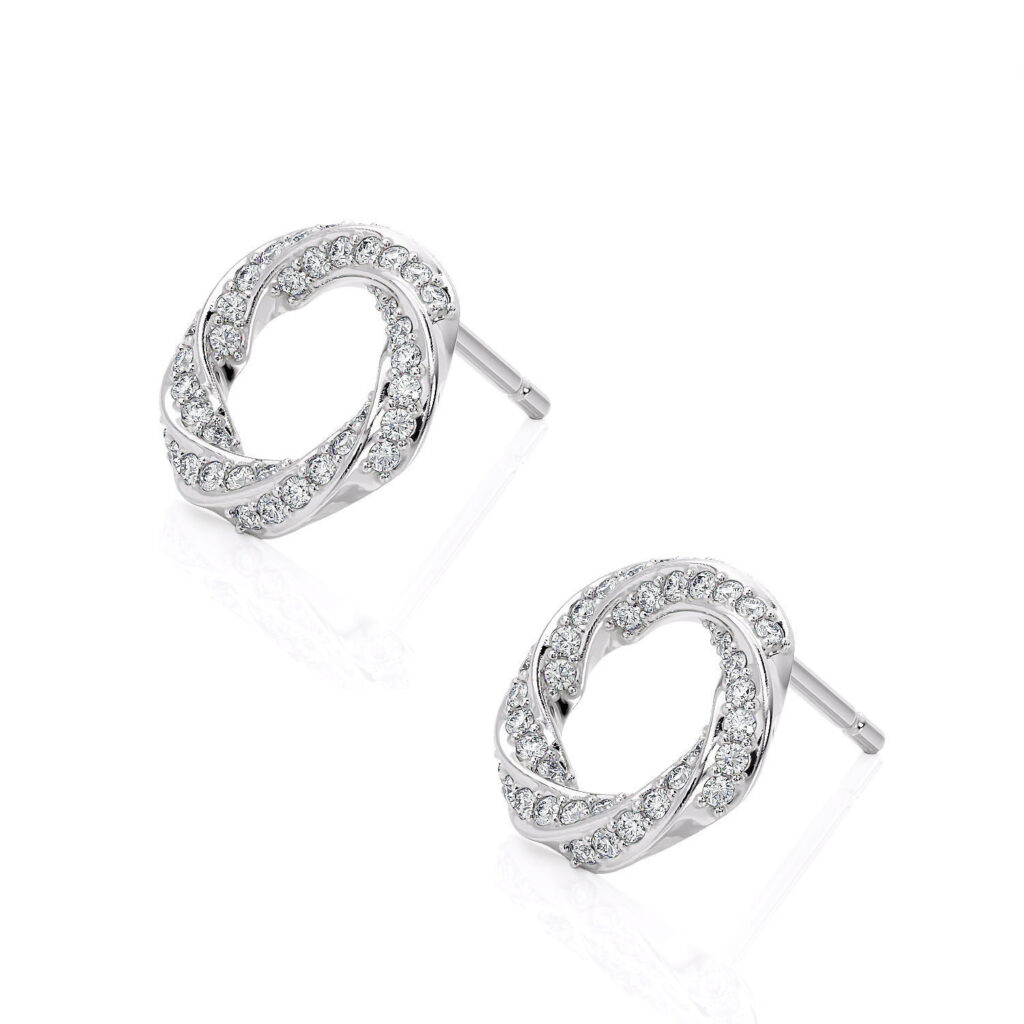
Cercle Diamond Stud Earrings – 18K Gold – 0.77ct
18K Gold
£4,610 Add to cart -
Katy Bracelet II – 18K Gold, White Gold
18K Yellow Gold, White Gold
£2,031 Select options This product has multiple variants. The options may be chosen on the product page -
Love Pendant II – 18K Gold, White Gold
18K Yellow Gold, White Gold
£4,813 Add to cart
4. Personal Style Identity: How Sculptural Silver vs Minimalist Gold Reveals Your Aesthetic Philosophy
The sculptural silver vs minimalist gold question ultimately isn’t about metal—it’s about identity. About whether you find beauty in abundance or absence, drama or discipline, maximalism or essentialism.
The Sculptural Silver Personality
People gravitating toward sculptural silver often share certain aesthetic and psychological characteristics:
Visual Preferences:
- Appreciation for art jewelry, gallery-quality design, pieces that blur the line between adornment and sculpture
- Comfort with visual boldness—being the focal point rather than blending seamlessly
- Attraction to texture, dimension, and tactile presence
- Interest in avant-garde fashion, architectural clothing, monochromatic dressing that provides a canvas for statement jewelry
Lifestyle and Self-Expression:
- Viewing jewelry as wearable art, not just accessorizing
- Finding power in visibility and unapologetic self-expression
- Appreciation for handmade, artisan-crafted objects with visible maker’s marks
- Comfort with standing out, making deliberate style choices that invite conversation
- Often working in creative fields or environments where personal style expression is valued
Wardrobe Integration:
- Sculptural silver becomes the hero piece; clothing provides support
- Preference for solid colors, architectural cuts, and clean silhouettes that don’t compete with jewelry
- Minimal pattern, maximum texture—knits, leather, structured fabrics
- Often fewer jewelry pieces but each is significant and deliberately chosen
The Minimalist Gold Personality
Those drawn to minimalist gold typically exhibit different aesthetic priorities:
Visual Preferences:
- Appreciation for restraint, precision, and the difficulty of executing perfect simplicity
- Comfort with quiet confidence—making impact through refinement rather than volume
- Attraction to clean lines, geometric forms, and intentional negative space
- Interest in timeless design, subtle luxury, and pieces that integrate seamlessly across contexts
Lifestyle and Self-Expression:
- Viewing jewelry as personal signature—consistent, recognizable, but never overwhelming
- Finding power in curation and the discipline of choosing only what’s essential
- Appreciation for fine craftsmanship that doesn’t announce itself
- Preference for versatility and pieces that transition effortlessly from professional to social settings
- Often working in fields where understated elegance is valued or required
Wardrobe Integration:
- Minimalist gold acts as punctuation, not exclamation
- Layering multiple delicate pieces to create visual interest through repetition
- Appreciation for how gold warms and complements skin tone without drawing attention away from face or overall silhouette
- Often larger jewelry collections with each piece serving a specific styling purpose
The Hybrid Approach
Here’s where the sculptural silver vs minimalist gold conversation gets truly interesting: the most sophisticated jewelry wardrobes often incorporate both aesthetics, understanding that different contexts, moods, and outfits call for different energies.
Mixing sculptural silver and minimalist gold:
- Sculptural silver cuff + delicate gold chain necklace = unexpected contrast that works precisely because it breaks the “rules”
- Minimalist gold ear stack + chunky silver rings = balancing restraint above the neck with drama on the hands
- Layering thin gold bangles with one sculptural silver statement piece = using repetition to create visual weight that can hold space next to bold forms
The key to successfully mixing sculptural silver and minimalist gold is intentionality. Random combinations feel accidental; deliberate pairings that acknowledge the contrast create visual interest.
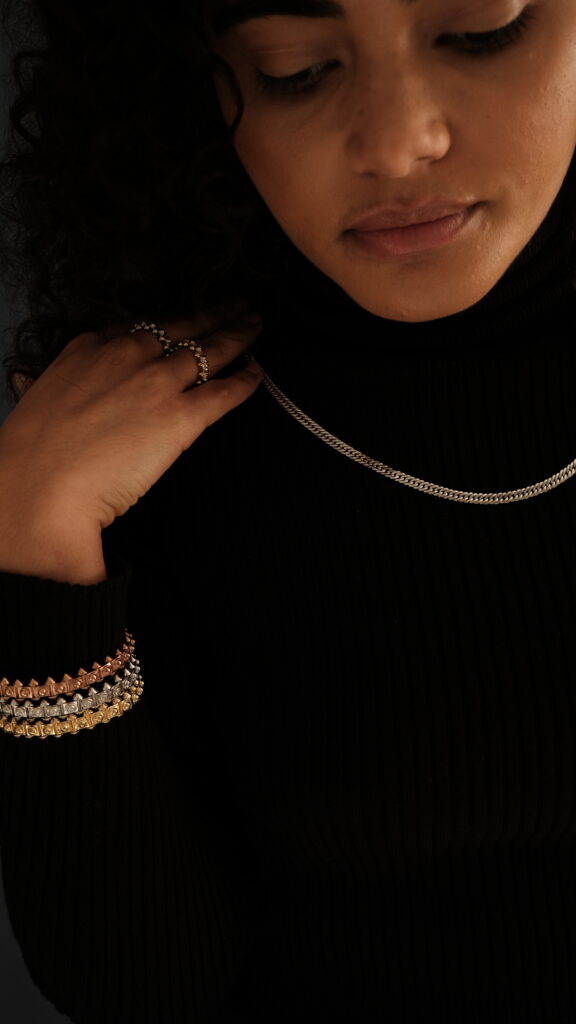
5. Wardrobe Harmony: Styling Sculptural Silver vs Minimalist Gold with Clothing Architecture
Understanding how sculptural silver vs minimalist gold interacts with clothing is essential to building a cohesive, intentional personal style.
Sculptural Silver Styling Frameworks
Best Clothing Pairings:
- Monochrome and neutrals: Black, white, grey, camel, navy—anything that provides a clean canvas for silver’s reflective drama
- Architectural cuts: Structured blazers, sculptural coats, asymmetric hemlines, oversized silhouettes that echo the jewelry’s dimensional presence
- Minimal patterns: If pattern appears, it should be geometric, large-scale, or tonal to avoid visual competition
- Textural fabrics: Chunky knits, leather, linen, raw silk—materials with substance that can hold visual space alongside bold jewelry
Styling Strategies:
- One statement piece per outfit: A sculptural silver cuff becomes the focal point; everything else supports it
- Consider negative space: Where the jewelry sits matters—a large necklace needs an open neckline; oversized rings need visible hands
- Balance proportion: Sculptural jewelry on delicate frames requires careful scale consideration; on larger frames, bold pieces create visual harmony
- Embrace intentional contrast: Sculptural silver against soft, draped fabrics creates interesting tension
Contexts Where Sculptural Silver Excels:
- Creative professional environments
- Gallery openings, art events, cultural gatherings
- Casual weekend styling where jewelry elevates basics
- Evenings where you want presence without traditional formal jewelry
Minimalist Gold Styling Frameworks
Best Clothing Pairings:
- Classic silhouettes: Tailored trousers, silk blouses, cashmere sweaters, structured dresses—timeless pieces that appreciate refined punctuation
- Refined patterns: Small-scale prints, subtle stripes, tone-on-tone patterns that won’t overwhelm delicate jewelry
- Luxe fabrics: Fine wools, silk, cashmere, high-quality cotton—materials with inherent elegance that align with minimalist aesthetic
- Layered neutrals: Beige, cream, soft greys, blush, olive—colors that allow gold’s warmth to glow against skin
Styling Strategies:
- Layering and stacking: Multiple minimalist pieces create impact through repetition—three thin bangles, four delicate necklaces at varying lengths
- Skin exposure: Delicate gold benefits from visible skin—open necklines, rolled sleeves, bare ankles with fine chain anklets
- Proportion through accumulation: What individual pieces lack in size, they gain through thoughtful layering
- Intentional restraint: Knowing when to stop adding pieces is as important as knowing which to include
Contexts Where Minimalist Gold Excels:
- Professional environments requiring polish without ostentation
- Formal events where refinement trumps drama
- Daily wear that transitions seamlessly from work to evening
- Situations where you want jewelry to enhance, not announce
The Sculptural Silver vs Minimalist Gold Photography Question
How each aesthetic translates through a camera lens—increasingly important in our visually documented lives—reveals another dimension of the sculptural silver vs minimalist gold divide.
Sculptural silver:
- Photographs with high contrast and graphic impact
- Creates shadows and highlights that read as dimensional even in flat images
- Stands out in group photos and environmental contexts
- Works beautifully in black-and-white photography
Minimalist gold:
- Photographs with warmth and subtlety
- Can disappear in low-light or distant shots but glows in close-ups
- Creates elegant, refined aesthetic in portrait photography
- Benefits from natural light to capture its luminosity
Neither is “better” for photography—but understanding how each translates through a lens helps inform styling choices for photographed events.
-
Empire Earring – 18K Sterling Silver
Sterling Silver
£434 Add to cart -
Flower Stud Diamond Earrings – 18K Gold – 1.7ct
18K Gold
£6,219 Add to cart -
Spun Link Necklace – 18K Gold
18K Gold
£4,844 Select options This product has multiple variants. The options may be chosen on the product page
6. Investment Strategy: Building a Jewelry Wardrobe in Either (or Both) Aesthetic Directions
Whether you’re committed to sculptural silver, devoted to minimalist gold, or strategically building a collection that incorporates both, approaching jewelry as an intentional investment rather than impulsive accumulation creates a more satisfying, wearable wardrobe.
The Sculptural Silver Collection Strategy
Foundation Pieces:
- One substantial cuff (wrist presence that works with everything)
- Statement earrings (either large hoops or sculptural drops)
- Signature ring (bold enough to stand alone, interesting enough to wear daily)
Next-Level Additions:
- Layering bangles (2-4 pieces that interact when stacked)
- Architectural necklace (transforms simple clothing into considered outfits)
- Sculptural ear cuffs or climbers (for those who want drama without piercings or with limited piercings)
Collector Pieces:
- Artist collaborations or limited editions
- Pieces with exceptional craftsmanship, unique forms, or gallery-quality design
- Cultural or historical references executed with contemporary vision
Investment Considerations:
- Sculptural silver value lies in design and craftsmanship, not metal content
- Seek out independent designers, artisan jewelers, and small production runs
- Condition matters less than with minimalist pieces—patina and wear can enhance value
- Focus on pieces that reflect your aesthetic even if trends shift
The Minimalist Gold Collection Strategy
Foundation Pieces:
- Perfect hoop earrings (the exact diameter and thickness that suits your face and personal style)
- Classic chain necklace (16-18 inches, versatile weight that layers or stands alone)
- Thin stacking rings or single band ring (daily wear that disappears into your baseline aesthetic)
Next-Level Additions:
- Layering necklaces at varying lengths (3-5 pieces that create subtle rhythm)
- Cuff or bangles for wrist punctuation (slim enough to stack, substantial enough to wear solo)
- Second ear piercings and delicate studs or huggies for ear layering
Collector Pieces:
- Heirloom-quality pieces in higher karats (18k or 22k for lasting investment)
- Designer-signed minimalist jewelry (Dinh Van, Jennifer Fisher, Mejuri’s elevated collections)
- Custom pieces that execute perfect proportions for your specific body
Investment Considerations:
- Minimalist gold value includes both design and metal content
- Higher karats (18k vs 14k) offer better color, less tarnish, higher resale value
- Condition is critical—scratches and dings reduce value more than with sculptural pieces
- Timelessness is the goal; avoid trend-driven proportions that will date quickly
The Hybrid Collection: Sculptural Silver AND Minimalist Gold
For those unwilling to choose—or those who understand that personal style isn’t one-dimensional—building a collection that incorporates sculptural silver vs minimalist gold as complementary rather than competing aesthetics creates the most versatile wardrobe.
Strategic Hybrid Approach:
- Context-based separation: Sculptural silver for creative/casual contexts; minimalist gold for professional/formal
- Intentional mixing: Understanding which pieces from each aesthetic can coexist harmoniously
- Seasonal rotation: Sculptural silver in winter with heavy knits and boots; minimalist gold in summer with refined, minimal clothing
- Mood-based selection: Sculptural silver for days requiring bold energy; minimalist gold for days valuing quiet confidence
The sculptural silver vs minimalist gold question doesn’t demand loyalty to a single answer. The most sophisticated jewelry wardrobes are built with self-awareness—understanding which aesthetic resonates with different facets of your identity and having the range to express them all.
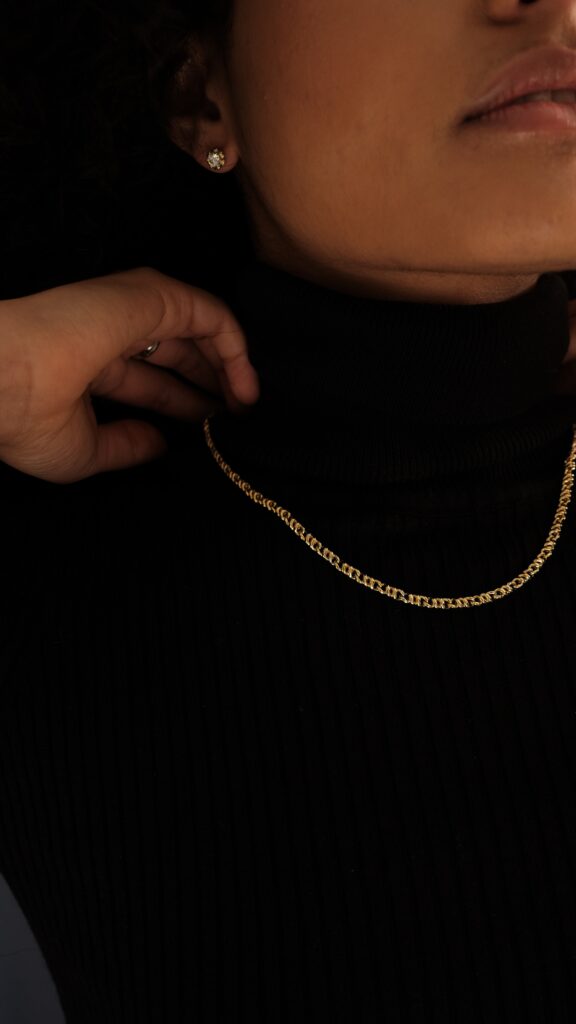
7. Breaking the Rules: Why Sculptural Gold and Minimalist Silver Deserve Consideration
While this article has focused on sculptural silver vs minimalist gold as the dominant pairings, it’s worth acknowledging that flipping the formula—sculptural gold or minimalist silver—creates equally valid (if less common) aesthetic statements.
Sculptural Gold: Maximum Impact, Warm Glow
Sculptural forms executed in gold—particularly yellow or rose gold—create a different energy than silver. The warmth softens the drama, making bold pieces feel less confrontational, more integrated with the body. Sculptural gold works particularly well when:
- The wearer has warm undertones and silver reads too harsh
- The design references cultural or historical jewelry traditions (African, Indian, Pre-Columbian) where gold’s spiritual significance matters
- The piece will be worn in warm-light environments (candlelit dinners, sunset events) where gold glows
- Investment value combines material worth with artistic design
Minimalist Silver: Cool Restraint, Modern Edge
Minimalist forms in silver create a contemporary, almost industrial aesthetic. The metal’s coolness and brightness give refined, simple pieces a modern edge that gold’s warmth doesn’t achieve. Minimalist silver excels when:
- The wearer has cool undertones and gold reads too yellow
- The aesthetic references Scandinavian or Japanese design principles (clean, functional, unadorned)
- The piece integrates with a wardrobe of greys, blacks, whites, and cool neutrals
- Budget allows for significant minimalist pieces in silver that would be prohibitive in gold
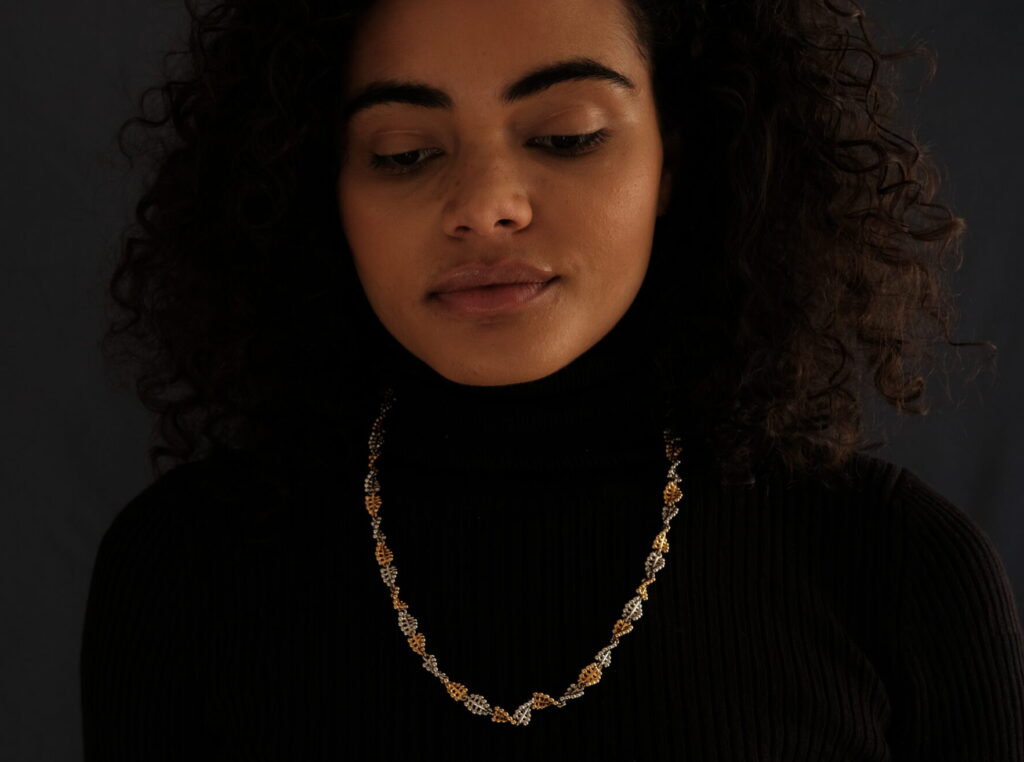
The sculptural silver vs minimalist gold framework isn’t prescriptive—it’s descriptive of the most common pairings. Understanding why these combinations work helps you make intentional choices, even when choosing to work against them.
-
Amoure Necklace – 18K Gold, Rhodium Plated Sterling Silver
Sterling Silver
£918 Select options This product has multiple variants. The options may be chosen on the product page -
Amoure Necklace – 18K Vermeil Gold
Sterling Silver
£918 Select options This product has multiple variants. The options may be chosen on the product page -
Serendipity Ring – 18K Vermeil Gold
Sterling Silver
£309 Select options This product has multiple variants. The options may be chosen on the product page
The Freedom of Knowing What Speaks to You
The sculptural silver vs minimalist gold question has never been about finding the “right” answer. It’s about understanding yourself well enough to know which aesthetic—or which combination of both—allows you to show up in the world as the most authentic version of yourself.
Sculptural silver offers the freedom of visibility, the power of three-dimensional presence, and the satisfaction of wearing jewelry that makes no apologies for taking up space. It’s for those who find beauty in volume, texture, and the conversation between form and negative space. It’s jewelry as art object, as statement, as the visual anchor of your personal style.
Minimalist gold provides the confidence of restraint, the sophistication of perfect proportion, and the versatility of pieces that integrate seamlessly across every context. It’s for those who appreciate the discipline of reduction, who understand that sometimes the most powerful statement is the quietest. It’s jewelry as signature, as subtle luxury, as the refined punctuation that completes your aesthetic.
The sculptural silver vs minimalist gold divide reveals that contemporary jewelry has moved beyond prescriptive rules and into the territory of personal aesthetic philosophy. There’s no hierarchy here—no “better” metal, no “more sophisticated” design approach. There’s only the question of which language you speak when you want your jewelry to communicate something about who you are.
Perhaps you’re someone whose style identity encompasses both aesthetics: sculptural silver for days requiring bold energy, minimalist gold for contexts demanding refined restraint. Perhaps you’ve discovered that mixing sculptural silver and minimalist gold creates the exact visual tension that feels most authentically you. Perhaps you’ve realized that one aesthetic so perfectly captures your design philosophy that building a collection exclusively in that direction brings more satisfaction than attempting versatility.
Whatever your answer, understanding the sculptural silver vs minimalist gold question as fundamentally about design philosophy, material character, and personal identity—rather than trend forecasting, metal hierarchies, or arbitrary style rules—empowers you to build a jewelry wardrobe that genuinely reflects your aesthetic vision.
Because at the end of the day, the sculptural silver vs minimalist gold conversation isn’t asking you to choose a side. It’s inviting you to understand your own visual language well enough that every piece you wear feels intentional, authentic, and unmistakably yours.