

Precious Metals
THE BEST SCULPTURAL SILVER EARRINGS FOR 2026
A diamond cut is a key factor to consider when choosing your next piece of diamond jewelry.
By Chinwe, Chief Creative Officer
Silver is no longer playing it safe. In 2026, the earring has become the most architecturally ambitious object in jewellery — and if you are still reaching for the same hoop or the same stud, you are missing the most exciting creative conversation happening in contemporary adornment right now. This guide is your invitation in.
This blog will explore the following:
- Why 2026 is a defining moment for sculptural silver earrings — and what is driving the shift
- What separates genuinely sculptural pieces from generic “statement” earrings
- The language of sculptural silver: form, material, weight, and surface
- Seven distinct aesthetic categories, each with design philosophy, standout examples, and styling guidance
- How to wear sculptural silver earrings with different face shapes, necklines, and hair styles
- How to build a sculptural silver earring wardrobe as a long-term investment in personal style
- Quality markers, care guidance, and answers to every practical question you have been asking
Whether you are buying your first truly artistic pair or expanding a collection you have been building for years, what follows will give you the framework, the vocabulary, and the conviction to choose pieces that will anchor your aesthetic identity for a long time to come.
Something has shifted. Not gradually, not quietly — but with the kind of decisive cultural energy that announces itself clearly once you know what to look for. Sculptural silver earrings are not simply popular right now. They are necessary in a way that jewellery rarely gets to be.
Several forces have converged at once, and understanding them matters — not because cultural context makes a pair of earrings more beautiful, but because it tells you something important about why these pieces are worth investing in now rather than waiting.
The maximalist jewellery resurgence has given the market permission for volume, drama, and genuine formal ambition. But this is not the maximalism of excess — it is sophisticated, form-led, and deeply intentional. The sculptural silver earrings emerging from independent studios and established ateliers in 2026 are not loud for loudness’ sake. They are architecturally considered objects that happen to be worn.
The silversmithing renaissance is raising the technical bar simultaneously. Techniques once confined to fine art metalwork — anticlastic raising, fold forming, hollow construction, reactive patination — are increasingly applied to jewellery forms, and the results are sculptural silver earrings of genuine complexity and artistic ambition. Craft schools from London to Seoul are producing graduates with the skills of sculptors and the sensibility of jewellers.
Gender-neutral design evolution has reshaped the formal vocabulary. The best sculptural silver earrings of 2026 are designed for faces and personalities, not for assumed gender identities. This freedom from conventional proportional expectations has opened entirely new formal territories.
Then there is sustainability. Silver is recyclable, traceable, and enduring. An investment in a well-made sculptural silver pair is an investment in something that will not contribute to fashion waste. It will, instead, become part of a personal collection that grows more meaningful with time — which is precisely the kind of value proposition that resonates with the way discerning buyers are thinking about luxury in 2026.
Finally, there is the rejection of logo luxury. A generation of buyers who spent the 2010s accumulating branded accessories has turned decisively toward objects where the value lives in the object itself — in the craft, the form, and the maker’s intelligence — rather than in what the label communicates to others. Sculptural silver earrings are the natural beneficiaries of this shift.
The Language of Sculptural Silver: What Separates This Category From Everything Else
Before we move into the aesthetic categories, it is worth establishing precisely what sculptural silver earrings are — and what they are not. Because the term gets used loosely, and the difference between genuinely sculptural earrings and mass-market “statement” pieces is consequential when you are making a real investment.
Sculptural silver earrings are distinguished by their engagement with three-dimensional form as a primary design value. Where conventional earrings deploy surface decoration, gemstone brilliance, or size for impact, sculptural pieces operate through volume, negative space, movement, asymmetry, and architectural presence. The question animating their design is not “how does this look?” but “how does this exist in space?”
The defining characteristics to look for:
- Volume and presence: genuine three-dimensionality, not a flat form with surface texture applied
- Negative space: the deliberate use of open space as a design element — voids as considered as the silver itself
- Organic or geometric abstraction: forms that reference natural structures or architectural systems without literal representation
- Asymmetry: intentional imbalance that creates dynamism and visual tension
- Movement: elements engineered to animate with wear — controlled swing, gentle rotation, responsive balance
- Surface complexity: finishes that interact with light in sophisticated ways — high polish reflecting environments, satin diffusing light, oxidised contrast creating depth
Silver as the Sculptor’s Medium
Sterling silver — 92.5% silver, marked 925 — is the standard for quality jewellery. It is strong enough to hold complex geometric forms, malleable enough to be raised, forged, and shaped by hand, and reflective enough to carry surface finishes ranging from mirror-bright to deeply matte. Fine silver (99.9% pure) has a whiter, more lustrous surface but is softer and less suited to structural forms. For sculptural work, sterling is the workhorse.
Oxidation deserves particular attention. Liver of sulphur and other patination treatments allow silversmiths to selectively darken recessed areas, creating tonal contrast that dramatically enhances sculptural depth. An oxidised finish on a hammered or textured surface transforms the piece from jewellery to object — from something worn to something encountered.
Weight distribution is the central engineering challenge of sculptural silver earrings. Volume implies weight, and weight at the earlobe requires careful management. The best pieces use hollow construction to achieve dramatic scale without discomfort. Titanium posts and leverback fastenings distribute load and reduce fatigue during extended wear. When evaluating any sculptural pair, ask whether the design has addressed weight before you commit.
The Seven Aesthetic Categories of Sculptural Silver Earrings in 2026
1. Architectural Modernism: Geometry With Dimensional Depth
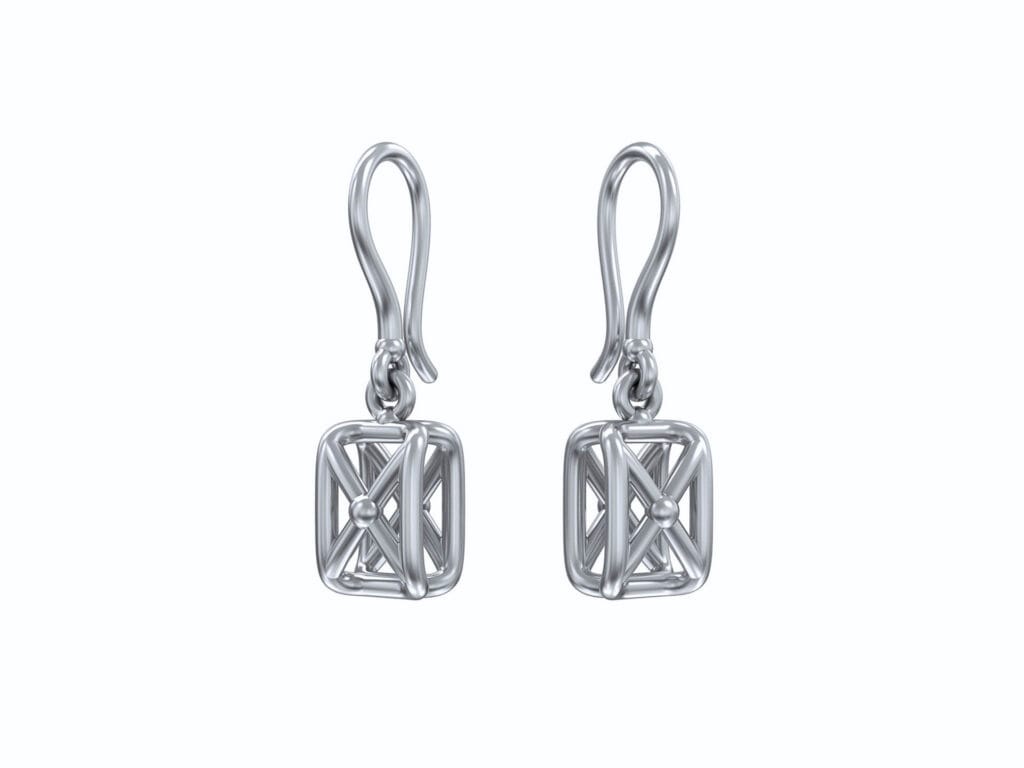
If the Bauhaus had trained jewellery artists with the same rigour it applied to furniture and typography, the result might look something like this category. Architectural Modernism in sculptural silver earrings distils complex three-dimensional geometry to its essential logic — triangulated planes, interlocking volumes, negative space engineered with the precision of a structural engineer working in miniature.
The design philosophy here is one of disciplined reduction: every element earns its place, every angle creates a relationship with adjacent forms, and the whole exceeds the sum of its parts. These are not simple geometric earrings. They are geometric systems.
The most compelling pieces in this category include interlocking triangulated forms in oxidised sterling that create moiré-like visual effects as they move; hollow cube constructions at the ear that play with the paradox of solidity and transparency; and angular compositions where three or four planes of polished silver create an almost prismatic effect in changing light. Among the names consistently associated with this formal territory: Babette Wasserman for clean modernist geometry, and the geometric works coming out of emerging London-based studio graduates working in the lineage of minimal metalwork.
These sculptural silver earrings demand equally architectural clothing. Pair with structured blazers and tailored coats in monochrome palettes, high necklines that frame the jaw and allow the earring to function as a standalone focal point, and sleek updos that do not compete with the geometry. Restrained makeup — a graphic liner or a strong brow — echoes the earring’s angularity without overwhelming it.
2. Organic Abstraction: Biomorphic Forms and the Language of Nature
Organic Abstraction is perhaps the richest category in contemporary sculptural silver earrings — and the most technically demanding to execute with genuine artistic authority. The challenge is to reference natural forms (bone, seed pod, eroded stone, root structure, wave, cellular membrane) without illustrating them. The best pieces carry the memory of organic systems without being identifiable as any specific natural object.
This is where casting frequently dominates, because the fluidity of organic form is most naturally achieved through lost-wax processes. The most sophisticated pieces combine casting with hand-finishing to create surfaces of extraordinary tactile complexity — the sense that what you are holding was not manufactured but grown, or found, or excavated.
Outstanding organic abstraction this year includes free-form sterling drops that appear caught mid-movement — as though liquid silver was suspended at the instant of becoming solid; pairs that explore the formal vocabulary of erosion, with surfaces transitioning from polished high points to matte, oxidised depths in a way that recalls water-worn stone; and small, dense forms referencing cellular or molecular structures, carrying enormous visual density in a compact scale.
Georg Jensen’s archival organic pieces — particularly the work originally designed by Nanna Ditzel — remain reference points for this aesthetic. Among contemporary makers, the organic work of London-based artist-jeweller Hannah Bedford demonstrates what this category can achieve at the highest level.
Asymmetric pairs are particularly well-suited to organic abstraction: two earrings clearly related in formal language and material treatment, but not identical. This productive asymmetry references the imperfection of natural systems and allows visual complexity that perfectly matched pairs cannot achieve.
Styling: draped or softly structured clothing in natural material palettes — ivory, ecru, warm grey, stone, deep forest green. Hair worn down with soft texture creates an appropriate visual context. Warm, skin-tone-adjacent makeup: bronzer, nude lip, sculptural cheekbone.
-
Micro Pave Stud Earrings – 18K White Gold
18K White Gold
£2,105 Add to cart -
Tennis Bracelet – 18K White Gold – 12.7ct
18K White Gold
£44,964 Select options This product has multiple variants. The options may be chosen on the product page -
Tennis Necklace – 18K White Gold – 26.67ct
18K White Gold
£59,600 Select options This product has multiple variants. The options may be chosen on the product page
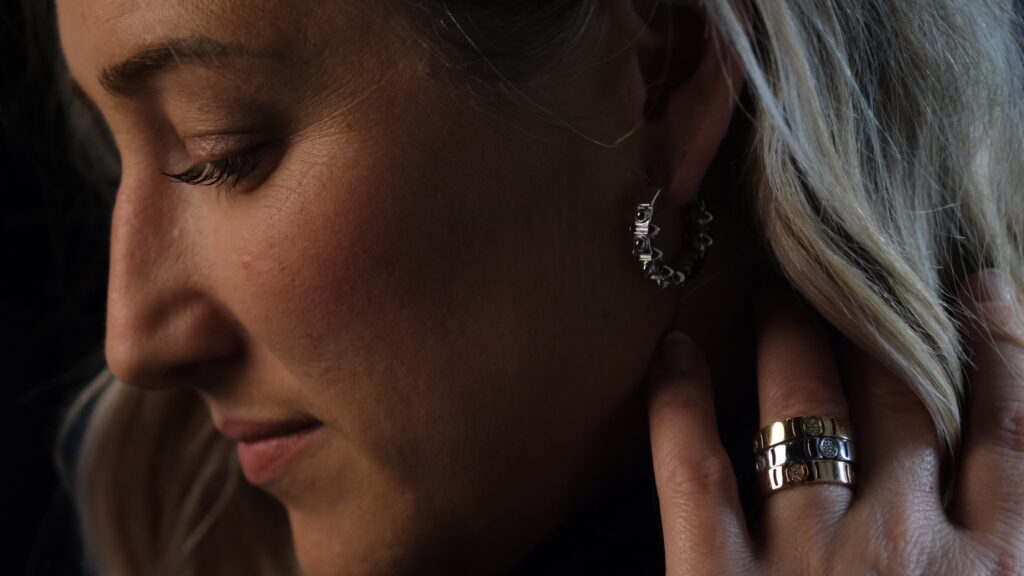
3. Kinetic Movement: Earrings That Animate With Wear
Jewellery has always moved with its wearer, but kinetic sculptural silver earrings foreground movement as a primary design value — engineering swing, rotation, and responsiveness into the form itself. These are pieces where stillness is almost an afterthought. They are designed to be experienced in motion.
The engineering challenge is considerable. Movement must be controlled: too free and the piece tangles or distorts; too constrained and the kinetic quality is lost. The best examples find a precise balance — a gentle, predictable arc of motion that creates visual rhythm without unpredictability.
Standout pieces in this category include multi-element drop earrings where horizontal silver planes at different lengths swing independently, creating a time-delay visual effect as the wearer moves; geometric pendants on carefully calibrated loops that allow slow rotation, presenting different faces of the form to the viewer at different moments; and earrings built around pivot points, where two or three elements fold and unfold as the wearer’s head moves. Vivianna Torun Bülow-Hübe’s kinetic works for Georg Jensen remain the canonical reference. Contemporary kinetic silverwork from makers trained in the Scandinavian tradition continues this lineage with fresh formal thinking.
Particularly sophisticated kinetic sculptural silver earrings incorporate counterweights — secondary elements engineered to balance the primary form and produce a specific swing pattern. These pieces reveal their full design intelligence only in motion, making them worth seeking in person or through video content before purchase.
Styling: evening and occasion wear, where movement is most visible. Open necklines — V-neck, off-shoulder, strapless — allow the full length to be appreciated. Hair firmly up. Consider matching the rhythm of your outfit to the earring; flowing fabrics in motion create a unified kinetic aesthetic.
-
Cluster Stud Diamond Earrings-18K White Gold-1.7ct
18K White Gold
£4,880 Add to cart -
Linear Diamond Tip Bracelet 0.43ct – 18K Rose Gold
18K Rose Gold
£13,655 Select options This product has multiple variants. The options may be chosen on the product page -
Mosaïque Bracelet – Sterling Silver
Sterling Silver
£451 Select options This product has multiple variants. The options may be chosen on the product page
4. Brutalist Drama: Unapologetic Weight and Raw Presence
Brutalism in jewellery shares its architectural namesake’s commitment to material honesty and formal power — and its willingness to be confrontational. Brutalist sculptural silver earrings are not subtle. They present their construction openly, wear their weight without apology, and occupy visual space with an authority that is impossible to ignore.
The formal vocabulary includes deliberately rough surface textures that read as intentionally unresolved; chunky, low-gauge forms with visible hammer marks; asymmetric volumes that appear torn or fractured rather than designed; and an aesthetic that deliberately refuses conventional jewellery prettiness in favour of something rawer and more architecturally assertive.
The most compelling brutalist sculptural silver earrings this year include heavily oxidised, chunky hoops beaten into imperfect circles — each pair unique in its specific distortion; oversized organic blobs of sterling that simultaneously reference geological and industrial forms; and assemblages of rectilinear silver elements stacked and soldered into composite forms that read like architectural models or urban fragments. Maria Goti’s work and the rough-hewn silver practice of several graduates from London’s Royal College of Art jewellery programme exemplify this aesthetic at its most intentional.
Crucially, brutalist sculptural silver earrings are not careless. The best examples demonstrate extraordinary formal intelligence — the “rough” surface is entirely deliberate, each texture precisely placed. What looks accidental is deeply considered. This is the difference between brutalism and poor craft, and it is immediately apparent to an educated eye.
Styling: clothing of equivalent weight — heavy knitwear, denim, canvas, leather. Industrial colour palettes: black, concrete grey, raw denim, military olive. Confident minimal styling for everything else. These pieces genuinely transform casual dressing into a style statement and need no special occasion to justify them.
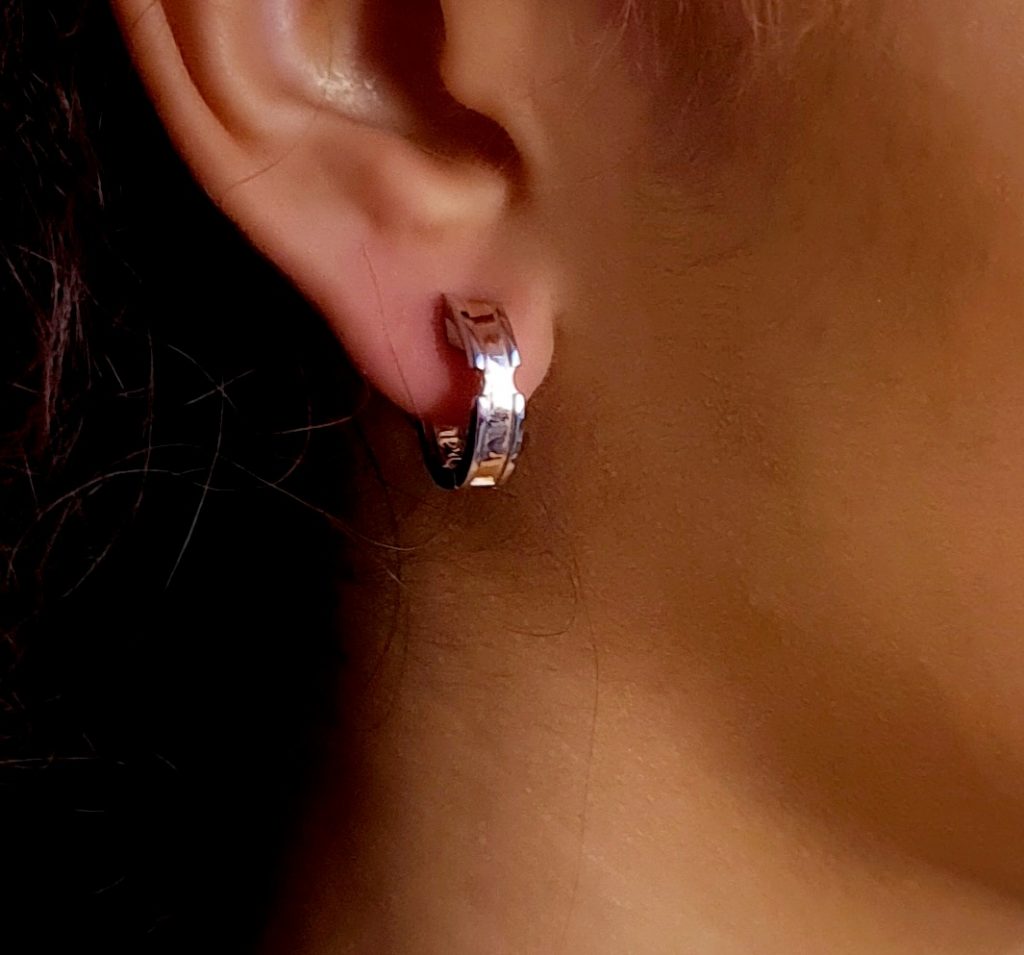
5. Minimalist Sculpture: Refined Volume and Essential Form
There is a paradox at the heart of minimalist sculptural silver earrings: they are both the easiest to wear and the hardest to design well. Reduced to their essential form, these pieces have nowhere to hide. Every curve, every plane, every decision about proportional relationship is fully exposed. Executed with genuine mastery, minimalist sculptural silver earrings achieve an almost meditative visual presence — the sense that the maker found the precise point beyond which no element could be removed without losing the whole.
This is not simple jewellery. Simple jewellery is thin hoops and diamond studs. Minimalist sculptural silver earrings have genuine three-dimensional volume and spatial presence; they simply achieve that presence through reduction rather than accumulation.
Outstanding pieces in this category include a single curved plane of polished sterling offset from the ear to create shadow and depth; a small sphere of hollow silver sitting just forward of the lobe, its weight and surface perfection communicating everything the design needs to communicate; and a folded form — two planes of silver joined at a precise angle — that creates entirely different profiles when viewed from front, side, and three-quarter position. Tiffany & Co.’s Elsa Peretti collaborations remain the high-water reference mark.
Among contemporary makers, the refined minimalist works of Charlotte Chesnais and the quieter pieces from Completedworks demonstrate what the category looks like at its most considered.
Scale is the critical decision in minimalist sculptural silver earrings: too small and the sculptural intent is lost in the noise of the face; too large and the piece moves out of the minimalist register entirely. The sweet spot is a scale that reads clearly from a conversational distance but rewards close attention.
Styling: these are the most versatile sculptural silver earrings in any wardrobe — professional contexts, casual wear, and evenings alike. Monochrome or tonal dressing allows the earring’s sculptural quality to register without competition. The only styling mistake is pairing them with other strong jewellery; they are designed to be heard alone.
6. Avant-Garde Experimentation: Asymmetry, Materiality, and the Refusal of Convention
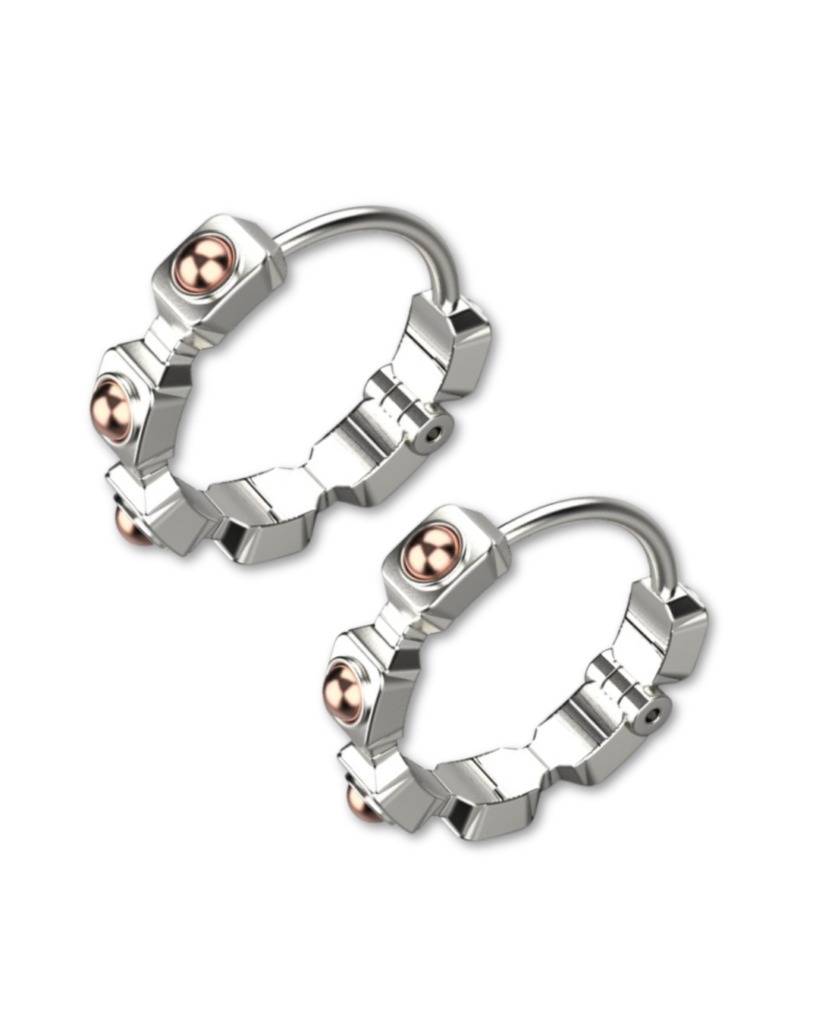
This category belongs to jewellery artists for whom conventional earring formats are simply insufficient for their formal ambitions. Avant-garde sculptural silver earrings may incorporate unconventional materials alongside sterling — oxidised copper, niobium, reclaimed industrial fragments, textile elements, resin — and typically deploy asymmetry not as a design flourish but as a fundamental formal commitment.
These are the most demanding sculptural silver earrings to wear — and the most rewarding when worn with confidence and purpose. They require a wearer who understands the piece’s design intentions and can inhabit its formal logic through their overall aesthetic. Worn with uncertainty, avant-garde earrings read as costume. Worn with conviction, they define a personal aesthetic vocabulary that nothing else can approximate.
The most exciting avant-garde sculptural silver earrings emerging from independent studios include ear-spanning constructions that move beyond the conventional lobe position to engage the entire ear as a canvas; pairs where one earring is a dense, compact form and the other is an airy, open structure — the tension between them generating the visual meaning; and works that incorporate deliberate surface interventions (scratching, partial gilding, selective patination) that read as drawing on metal.
Styling: confident dressing with clear aesthetic intentionality. Mix of high and low, constructed and deconstructed. Hair choices are critical — the earring must be visible and uncompromised by volume. A single avant-garde sculptural silver earring worn deliberately, leaving the other ear bare or with a single small stud, is an increasingly considered approach.
-
Empire Earring – 18K Sterling Silver
Sterling Silver
£434 Add to cart -
Flower Stud Diamond Earrings – 18K Gold – 1.7ct
18K Gold
£6,219 Add to cart -
Spun Link Necklace – 18K Gold
18K Gold
£4,844 Select options This product has multiple variants. The options may be chosen on the product page
7. Heritage Craft Reimagined: Traditional Technique, Contemporary Form
The final category belongs to jewellery artists who have mastered the deep tradition of silversmithing — repoussé, chasing, granulation, filigree, niello, engraving — and applied those techniques to forms that are unambiguously contemporary. These sculptural silver earrings carry genuine craft lineage without nostalgia, and in 2026 they represent perhaps the most compelling case for jewellery as long-term investment.
The forms produced by heritage craft techniques are genuinely unreplicable by industrial processes. The dimpled richness of hand-chased silver, the topographic complexity of repoussé work, the almost impossible delicacy of filigree — these are surfaces that take years to master and hours to execute. Wearing them is to carry a condensed history of human skill at your ear.
Heritage craft sculptural silver earrings of particular note include repoussé drops where abstract relief compositions have been raised from the back of the sheet, creating surfaces with the expressive depth of low-relief sculpture; filigree constructions where the traditional lace-like silver wire technique has been deployed in three-dimensional, non-traditional forms rather than flat decorative applications; and granulation work — the ancient technique of fusing tiny silver spheres to a surface without solder — applied to contemporary geometric earring forms.
Hector Miller’s updated filigree pieces and the repoussé silver work coming out of Copenhagen’s jewellery community illustrate how thoroughly tradition can be refreshed by contemporary formal intelligence.
Styling: historical and cultural resonance creates a productive tension when worn with contemporary or deliberately casual clothing. Avoid overly “folkloric” pairings that undercut the contemporary quality of the craft application. Statement colour or bold print coordinates particularly well with heritage craft silver — the visual complexity of the earring earns an equally confident surrounding aesthetic.
How to Wear Sculptural Silver Earrings: Styling Intelligence for Every Context
Sculptural silver earrings are often presumed to be occasion-only pieces — reserved for evenings, events, and special contexts. This is a mistake, and it impoverishes both the earring and the wearer. The most sophisticated wearers understand that sculptural silver earrings are daily companions, not ceremonial objects, and that the skill lies not in reserving them but in calibrating them.
Face Shape and the Foundational Conversation
Before necklines, before outfits, before hair — sculptural silver earrings enter into conversation with the face. Elongated faces carry large-scale, horizontally-oriented pieces beautifully — forms that extend outward from the ear, adding visual width. Angular faces are softened by organic abstraction forms with fluid edges. Round faces gain definition from sculptural silver earrings with vertical emphasis or geometric angularity. Strong jawlines can handle the visual weight of brutalist pieces that might overwhelm a more delicate bone structure.
Neck length matters equally. Long necks carry large-scale drop earrings with ease, allowing the full spatial presence of a kinetic or architectural piece to be appreciated. Shorter necks are better served by sculptural silver earrings with contained scale that sits close to the lobe rather than extending dramatically downward.
Necklines That Work
The relationship between a sculptural silver earring and a neckline is architectural. High necklines (turtlenecks, mandarin collars, boat necks) frame the face and create a clean backdrop for earrings with strong geometric or structural character. V-necks draw the eye downward and compete with drop earrings — counterintuitively, they pair best with sculptural silver earrings of contained scale or strong horizontal emphasis. Off-shoulder and strapless necklines are the natural partners of dramatic drops, creating a clear visual field from jaw to collarbone that allows the earring’s full spatial presence to register.
Monochrome dressing — a single colour or very close tonal range from top to bottom — creates the most powerful context for sculptural silver earrings. Without the visual noise of colour contrast or print, the earring’s three-dimensional form becomes the compositional event of the entire outfit. This is not neutrality. It is framing.
Hair Strategies
- Updos in all forms — chignon, French twist, braided crown, architectural bun — clear the stage entirely and allow sculptural silver earrings to occupy their designed spatial position without competition
- Side-swept styles offer a strategic asymmetric approach: one ear fully revealed, the other semi-framed — particularly powerful with a non-matching pair
- Hair worn down requires textural restraint: sleek, directional styles that do not create visual competition work well; loose, voluminous styles typically overwhelm smaller sculptural forms
- Curtain bangs and face-framing pieces at the front can enhance sculptural silver earrings by creating additional layers of visual framing
Professional Contexts
Scale, finish, and formality of form are the three variables to manage in professional environments. Minimalist Sculptural and Architectural Modernism pieces in polished or satin finishes at contained scales (up to approximately 3cm) are genuinely professional-context appropriate. Brutalist or Avant-Garde pieces at large scale read as personal expression statements that may or may not suit the specific professional environment.
The most practical professional approach: build a core selection of sculptural silver earrings at contained scales and refined finishes, then expand to more dramatically scaled pieces for evenings and occasions. This creates a coherent visual identity across contexts rather than a fractured collection.
When to Let Sculptural Silver Earrings Stand Alone
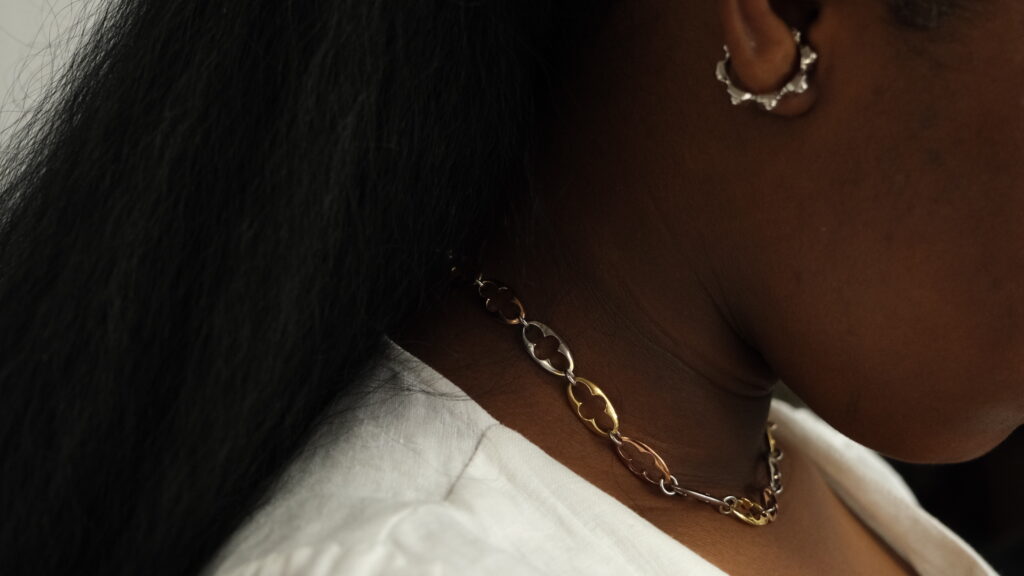
The most common styling error with sculptural silver earrings is over-layering — attempting to integrate them into a broader jewellery composition that includes necklaces, stacked rings, and multiple bracelets. Most sculptural silver earrings are designed to be the compositional anchor of the entire look. They do not need — and actively resist — competition.
The exception: a single, thin silver cuff or a carefully scaled ring in the same material can create a quiet material echo that feels considered rather than excessive. The rule is restraint, and the primary sculptural silver earring is always the gravitational centre of the composition
Building Your Sculptural Silver Earring Wardrobe: Investment, Quality, and Long-Term Value
The Three Pillars of Investment Value
The case for investing in quality sculptural silver earrings rests on three pillars: material durability, design longevity, and the growing collectibility of contemporary craft jewellery.
Sterling silver, properly maintained, is effectively permanent. Unlike fashion jewellery that degrades predictably with wear, a well-made sculptural silver earring will outlast the wardrobe it was bought to complement. The patina that develops with wear — slight darkening in recessed areas, warmth in the high-polish zones — is not degradation but evolution. Many wearers find their sculptural silver earrings become more beautiful over years, not less.
Design longevity is the harder claim to make, but the evidence is compelling: the jewellery pieces that have aged most gracefully are those designed around formal principles rather than trend references. A sculptural silver earring designed around principles of anticlastic geometry, organic biomorphism, or heritage craft technique has no expiry date. It cannot go out of fashion because it was never of a fashion to begin with.
Collectibility is the emerging dimension. As the artist-jewellery market matures — following the trajectory of the studio pottery and contemporary craft markets — the documented work of jewellery artists with exhibition records, published collections, and critical writing around their practice is becoming genuinely collectible. Buying from an artist early in their career is both the most financially accessible entry point and potentially the most significant investment.
Quality Markers: What to Look For
- Hallmarks: UK-made pieces carry assay office hallmarks — the lion passant for sterling, a maker’s mark, and a date letter. Verify authenticity with any significant investment.
- Post quality: titanium or 14k gold posts on silver earrings represent a genuine quality commitment — they prevent allergic reactions and resist wear. Surgical steel is an acceptable middle ground; plated posts are not.
- Fastening security: leverback closures are standard for valuable drops; comfort clutches on butterfly backs should have genuine resistance. For significant investments, screw-back conversions are available from most jewellers.
- Weight distribution: hold the earring between your fingers and assess balance. Well-designed sculptural silver earrings balance naturally; poorly engineered pieces tip or pull.
- Surface finish consistency: on polished pieces, the polish should be uniform and free of visible scratch lines. On hammered or textured surfaces, texture should be intentional in its directionality.
- Maker information: studio-made pieces should come with documentation of the maker. Anonymous “sculptural” earrings from mass-market retailers are a different category entirely.
Practical Care and Maintenance
Tarnish prevention: silver tarnishes through oxidation when exposed to air, particularly in environments with sulphur compounds (perfume, hairspray, polluted urban air). Store in airtight pouches — anti-tarnish cloth bags are ideal — when not in use. Silver does not tarnish from being worn; it is the periods of storage that create tarnish.
Cleaning: most high-polish or satin-finish sculptural silver earrings can be cleaned with a soft silver polishing cloth. Use gentle circular motions on open surfaces; a soft brush can access textured areas. Avoid submerging pieces with hollow construction in liquid cleaners.
Oxidised finishes require different treatment: these are intentional patinations and should not be polished. Clean only with warm water and a soft cloth; use a polishing cloth exclusively on the high points if light surface tarnish develops on raised areas.
Storage for complex sculptural forms: hollow or kinetic pieces should be stored individually to prevent elements contacting each other. Padded individual pouches or small anti-tarnish zip-lock bags work well for collections.
Answering the Practical Questions
Will they be too heavy? The best sculptural silver earrings are engineered for comfort. Hollow construction, titanium posts, and leverback fastenings make even dramatic pieces wearable for extended periods. Wear them for short periods initially and extend wear time gradually.
Will they tarnish? Yes — and this is not a problem. Tarnish is a natural silver behaviour easily addressed with a polishing cloth. Anti-tarnish storage prevents most tarnish from developing. The lived-in patina of regular wear is, to most wearers, an enhancement.
Can I wear them to work? With scale and finish calibration, absolutely. Contained-scale, refined-finish sculptural silver earrings are as appropriate in professional contexts as any other quality jewellery.
Are they worth the investment? For studio-made pieces from jewellery artists with documented practices: unequivocally yes. The price premium for genuinely handmade work reflects genuine differentiation in material, time, and artistic intelligence.
-
Asscher Cut Ring 18K Rose Gold- 0.20ct
18K Rose Gold
£4,025 Select options This product has multiple variants. The options may be chosen on the product page -
Cross Link Necklace – Sterling Silver
Sterling Silver
£737 Select options This product has multiple variants. The options may be chosen on the product page -
Empire Earring – 18K Sterling Silver
Sterling Silver
£434 Add to cart
Conclusion: Sculptural Silver Earrings as a Practice of Personal Evolution
The best sculptural silver earrings are not accessories. They are positions — formal arguments about beauty, materiality, and personal identity, expressed in three dimensions at the most visible point of your face. Choosing them with care and wearing them with conviction is an act of aesthetic self-definition that no other jewellery category quite replicates.
In 2026, the range of sculptural silver earrings available to the discerning buyer has never been richer — from emerging studio graduates working in anticlastic silver to established artist-jewellers whose pieces sit in museum collections. The challenge is not finding beautiful pieces. It is developing the curatorial eye to distinguish the genuinely exceptional from the merely competent, and the lasting from the merely current.
That eye is built through looking: visiting galleries and craft fairs, reading jewellery critics and material culture scholars, handling pieces in person rather than buying exclusively through images. It is also built through wearing: the education of a wearable art collection happens on your body, over time, through the lived experience of how different forms interact with your specific face, your specific wardrobe, and your specific way of moving through the world.
Invest deliberately. Buy slowly. Prioritise the work of makers whose practice you can trace, whose technical intelligence you can evaluate, and whose formal vision resonates with something specific in your own aesthetic sensibility. The sculptural silver earrings that will mean the most to you in five years are not the ones that were most universally admired when you bought them — they are the ones that were most accurately, personally yours.
This is the promise of sculptural silver earrings. And it is one the category is fully equipped to keep.